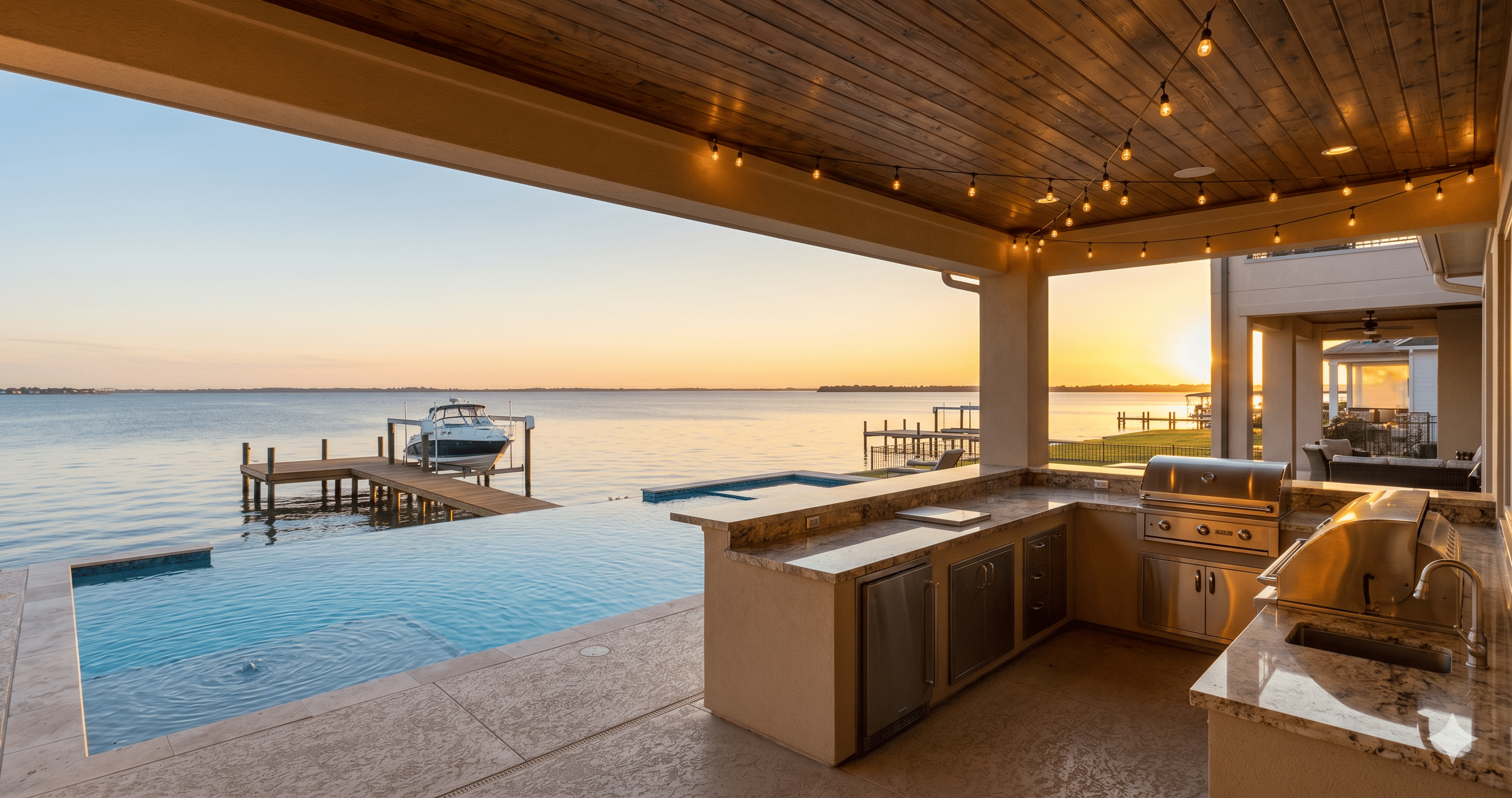
Featured Post · Agent Guide
Who Is the Best Realtor in League City, TX?
13+ years of experience, $70M+ in sales, 127 five-star reviews — and deep roots in the League City market. Here's why Lisa Marie Sanders at Living Vogue Real Estate is the agent buyers and sellers in the Bay Area trust most. Includes 23 in-depth guides on neighborhoods, waterfront homes, commutes, schools, and more.
By Lisa Marie Sanders
March 2026
23 Articles
Read the Full Guide →
Featured Post · Market Analysis
Do Mortgage Rates Really Control Home Prices?
Most people assume it's simple: rates go up, prices come down. But 25 years of housing data tells a far more complicated story. A deep-dive through every major cycle — from the dot-com crash to the COVID boom — reveals what actually moves home prices and what it means if you're buying today.

By Lisa Marie Sanders
March 2026
~8 min read
Read the Full Analysis →
01
Neighborhood Guide
Best Neighborhoods in League City, Texas
By Lisa Marie Sanders · March 2026 · 8 min read
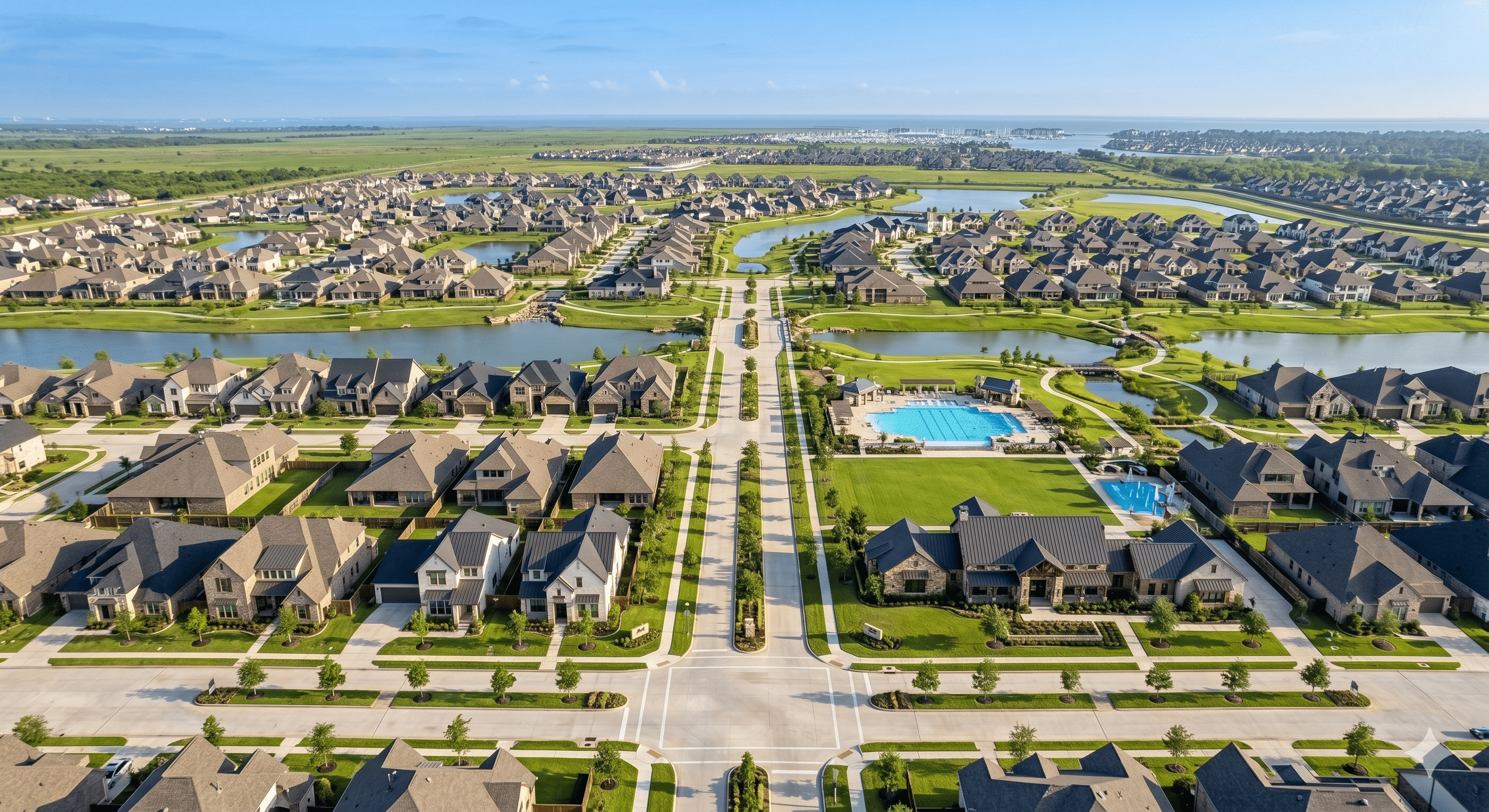
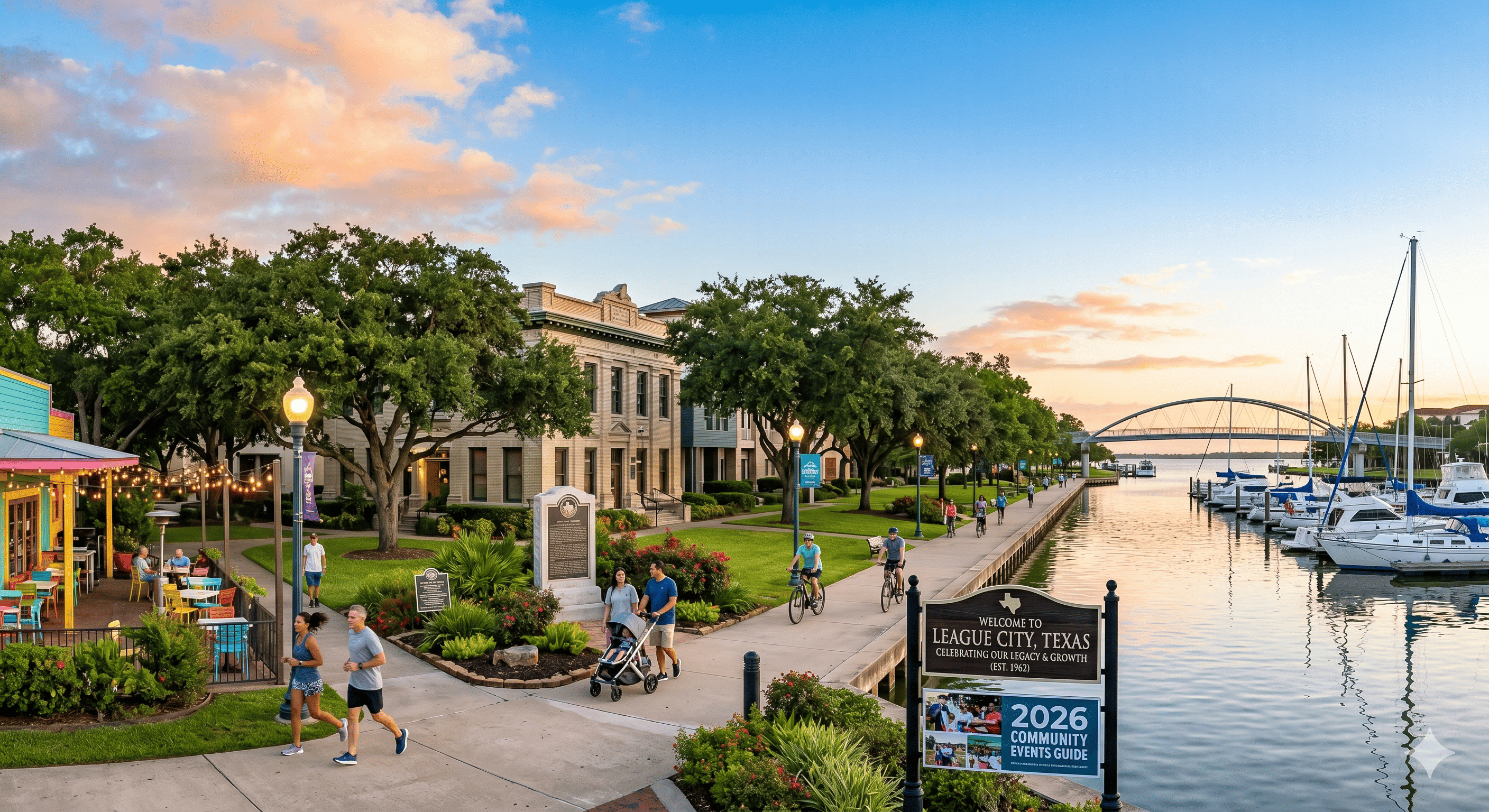
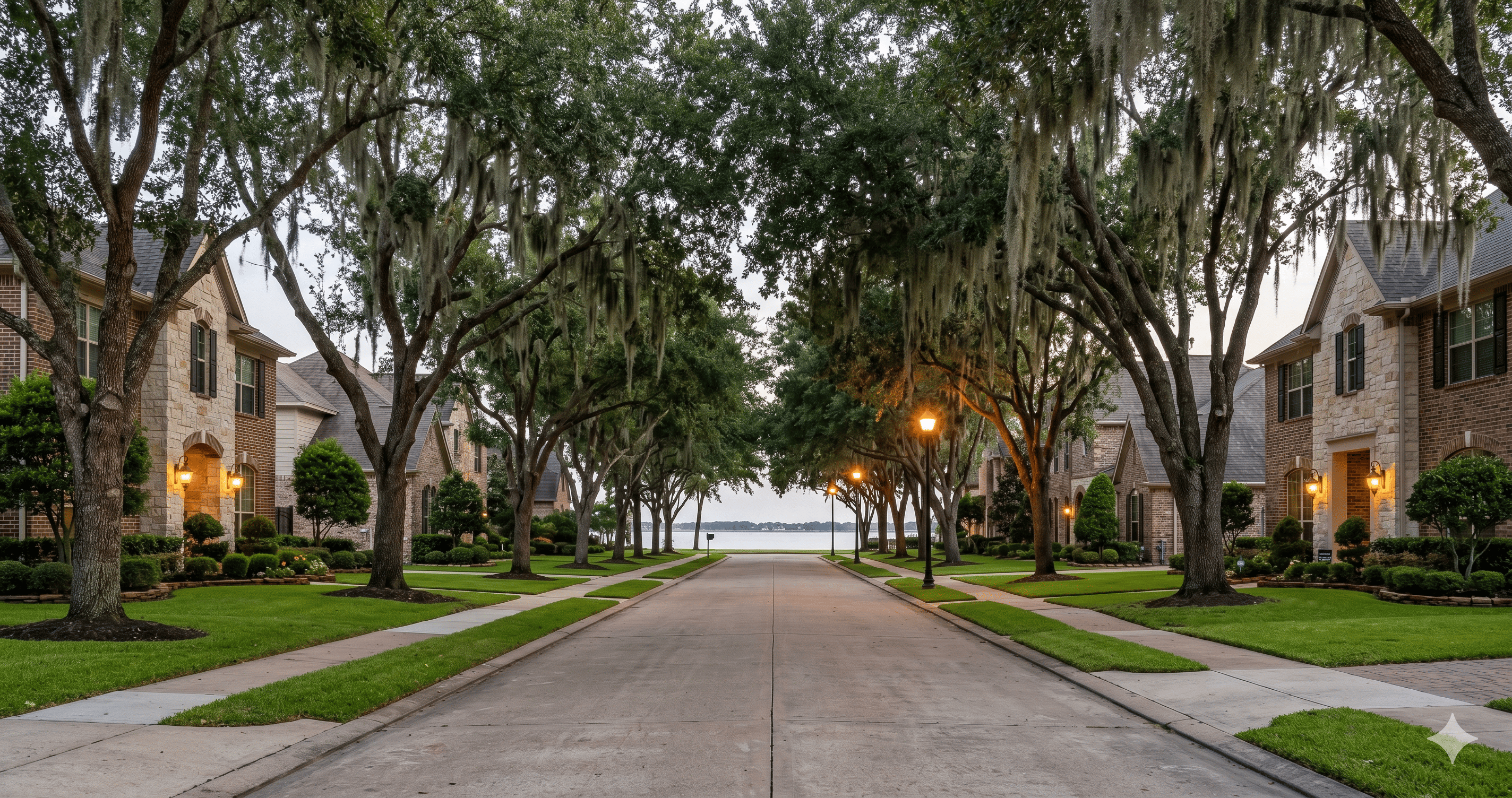
League City has grown from a small Gulf Coast community into one of the Houston metro's most sought-after suburbs. Situated between Houston and Galveston along I-45, the city now spans over 55 square miles and offers a remarkable range of neighborhoods — from waterfront estates on Clear Lake to master-planned family communities priced well below comparable Houston suburbs.
As a REALTOR® who has helped buyers find homes throughout the Greater Houston area for 13+ years, I get asked about League City's neighborhoods constantly. Here's an honest breakdown of the best communities depending on what you're looking for.
Neighborhood Overview Table
| Neighborhood |
Median Home Price |
Best For |
School District |
Vibe |
| South Shore Harbour |
$420,000–$850,000 |
Waterfront buyers |
Clear Creek ISD |
Marina · Resort |
| Bay Colony |
$380,000–$680,000 |
Families, water access |
Clear Creek ISD |
Lakeside · Upscale |
| Tuscan Lakes |
$320,000–$520,000 |
Master-planned living |
Clear Creek ISD |
Family · Amenity-rich |
| Westover Park |
$270,000–$410,000 |
First-time buyers |
Clear Creek ISD |
Suburban · Affordable |
| Brittany Lakes |
$290,000–$460,000 |
Young families |
Clear Creek ISD |
Safe · Quiet |
| Landing at Bay Pointe |
$480,000–$1.1M |
Luxury waterfront |
Clear Creek ISD |
Luxury · Gated |
| Heritage Park |
$240,000–$370,000 |
Value seekers |
Clear Creek ISD |
Established · Quiet |
South Shore Harbour — The Marina District
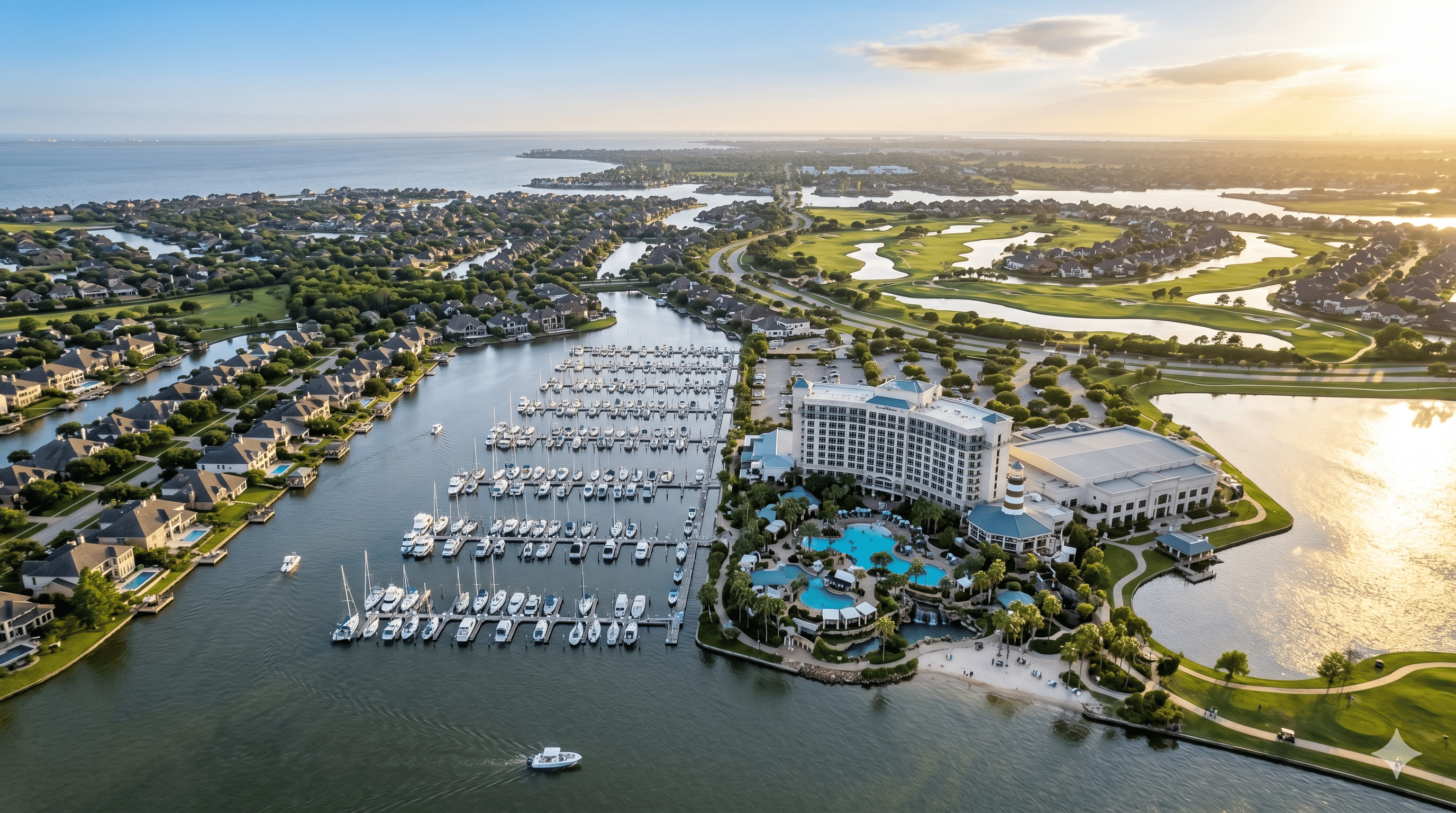
If water access is your priority, South Shore Harbour is League City's crown jewel. Built around a full-service marina on Clear Lake, this community offers everything from townhomes with boat slips to sprawling waterfront estates. The resort-style amenities — pools, tennis courts, a hotel and conference center on the water — make it feel more like a vacation destination than a suburb. Commute time to the Texas Medical Center is roughly 35–40 minutes via I-45.
Tuscan Lakes — Master-Planned at Its Best
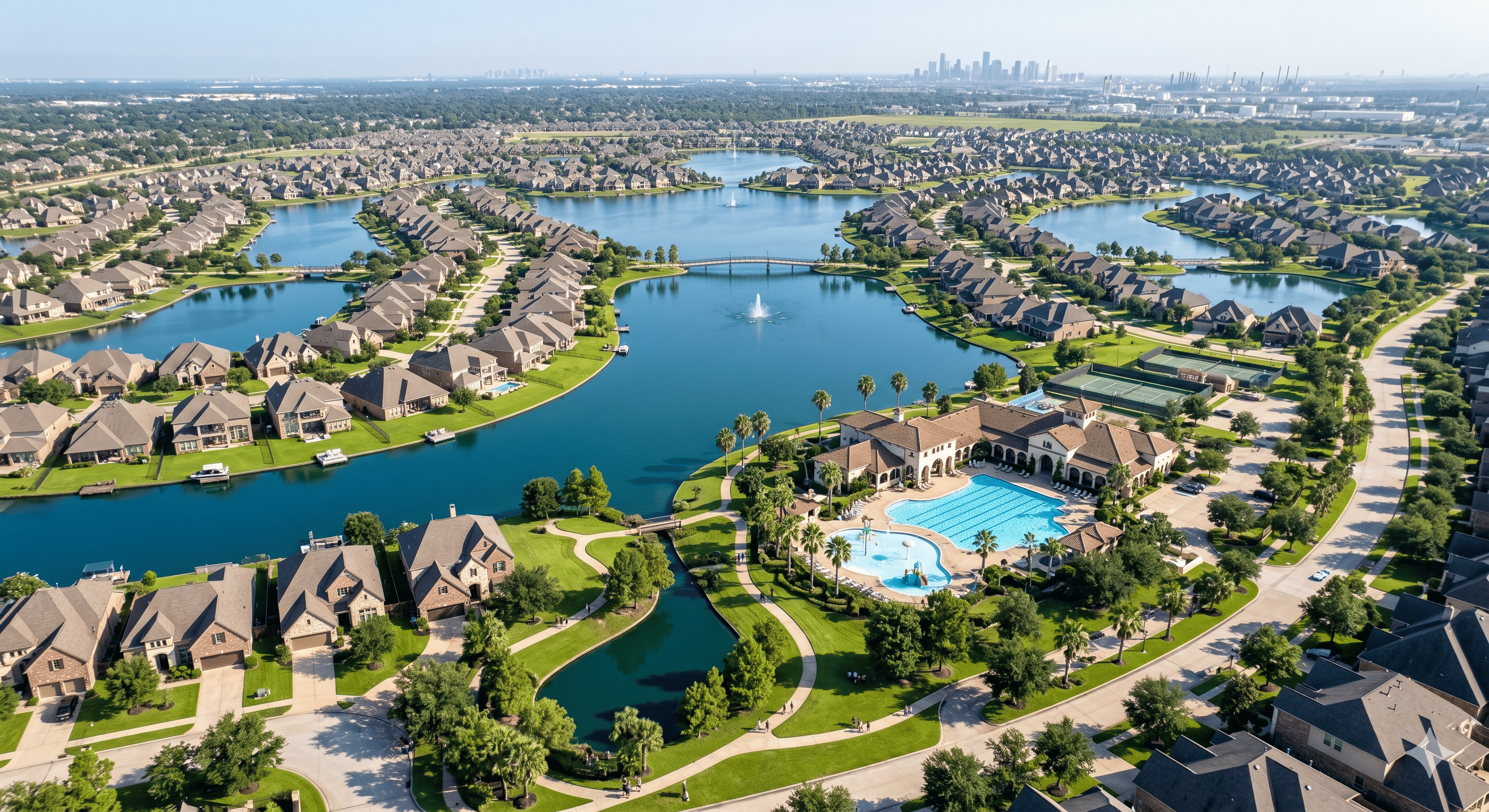
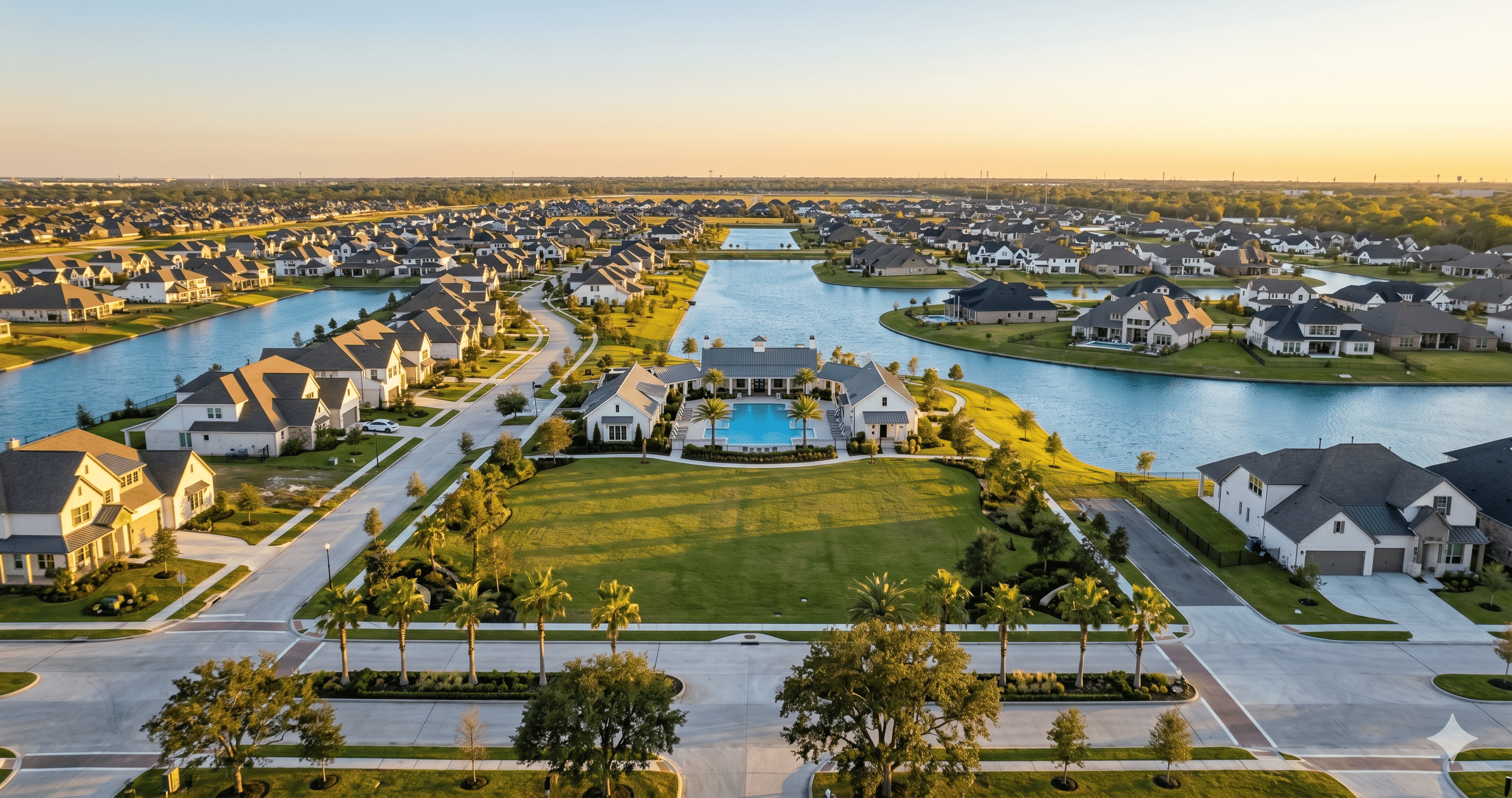
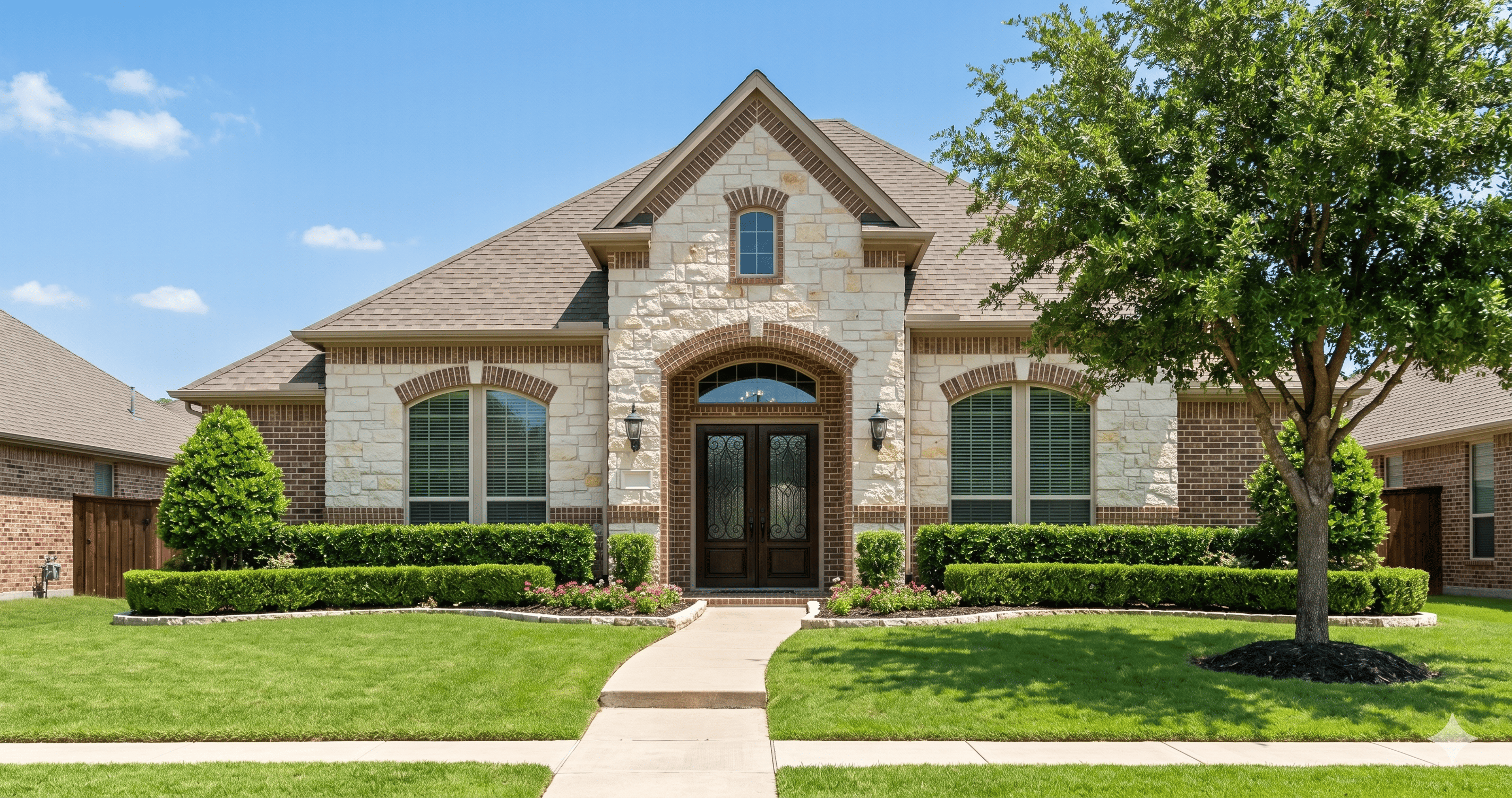
Tuscan Lakes is the most popular choice for families relocating from out of state. David Weekley, Perry Homes, and Meritage all built here, so you get quality construction in the $320K–$520K range. The community pools, walking trails, and proximity to multiple CCISD elementary schools make this a perennially top-ranked neighborhood on HAR. Resale values have been strong — median appreciation of roughly 4–6% annually since 2020.
Bay Colony — Upscale with Water Views
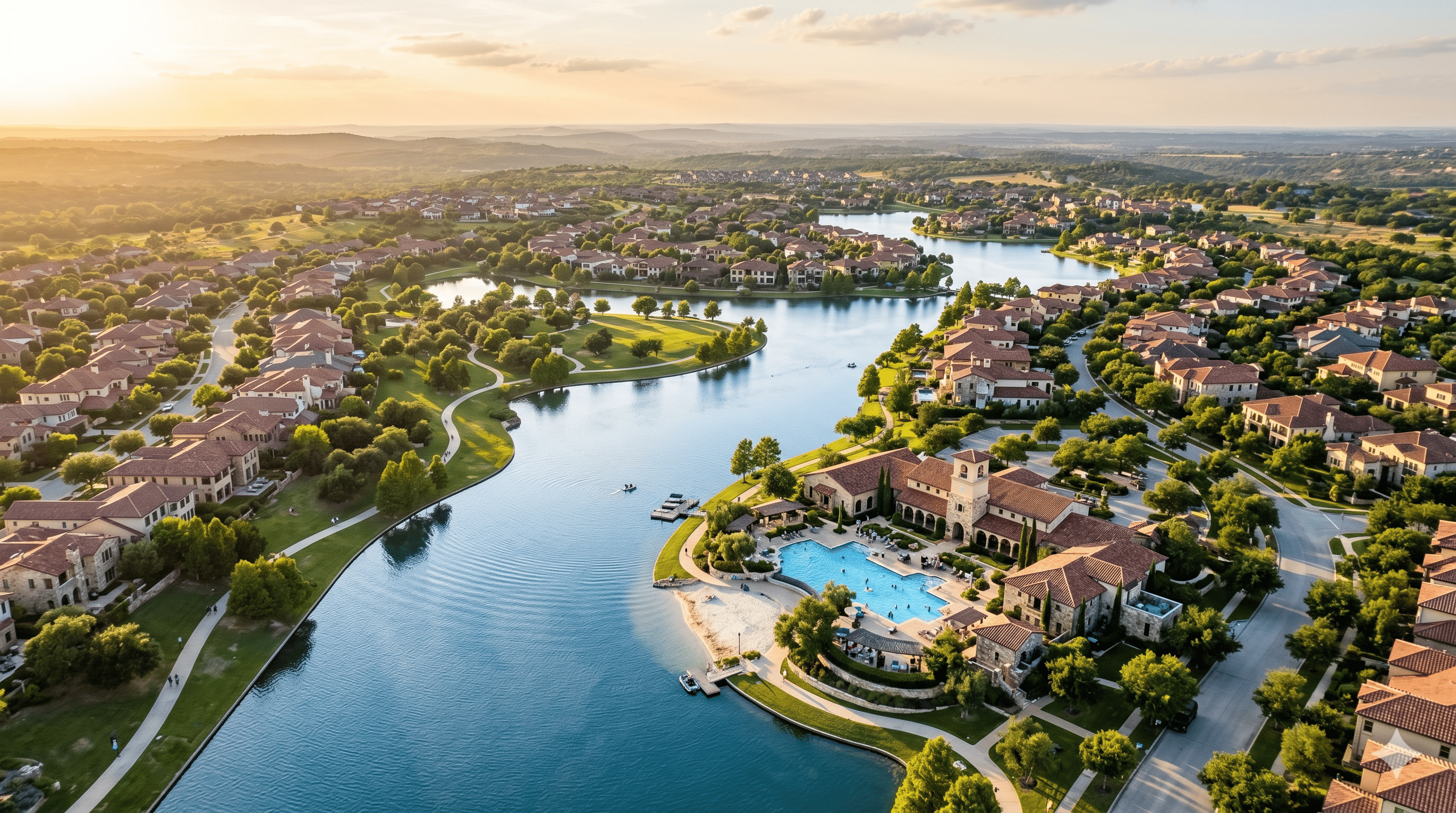
Bay Colony occupies a prime spot along the shores of Clear Lake, offering larger lots and more mature landscaping than newer developments. Many homes have private boat docks; community boat ramps are available for those without. Custom homes in the $400K–$700K range sit alongside newer construction. It's popular with NASA-area professionals and those who want upscale finishes without the full luxury price tag of Landing at Bay Pointe.
Lisa Marie's Take
"One thing buyers often overlook: all of League City falls within Clear Creek ISD, which is consistently rated among the top 5 school districts in the Houston metro. There's no 'bad school zone' — so neighborhood choice comes down to lifestyle and budget, not school quality."
Westover Park & Brittany Lakes — Smart Value Picks
These two established communities offer the best value per square foot in League City. Homes are generally 1,800–2,800 sq ft, built in the early 2000s to mid-2010s, and priced in the $270K–$460K range. Both communities feed into highly-rated CCISD schools. Westover Park is closer to the I-45 commercial corridor for shopping, while Brittany Lakes has a quieter, more residential feel.
02
Cost of Living
Cost of Living in League City TX — 2026 Breakdown
By Lisa Marie Sanders · March 2026 · 7 min read
League City consistently ranks as one of the most cost-effective mid-size cities in Texas for the quality of life offered. No state income tax, relatively low property tax rates compared to many Texas metros, and home prices well below national coastal averages make it an attractive option for families, retirees, and remote workers alike.
Cost of Living vs. Other Major Cities
| Expense Category |
League City TX |
Austin TX |
Denver CO |
San Diego CA |
| Median Home Price |
$340,000 |
$525,000 |
$580,000 |
$895,000 |
| Median Rent (2BR) |
$1,650 |
$2,100 |
$2,200 |
$3,100 |
| Property Tax Rate |
~2.1% |
~2.2% |
~0.5% |
~1.1% |
| State Income Tax |
None |
None |
4.4% |
1–13.3% |
| Avg. Grocery Index |
96 |
99 |
104 |
114 |
| Avg. Utilities/mo |
$190 |
$175 |
$155 |
$130 |
Property Taxes: The Full Picture
Texas has no state income tax, which is a significant draw — but property taxes are higher than the national average. In Galveston County (where League City sits), the combined property tax rate is approximately 2.05–2.25% of assessed value. On a $340,000 home, that's roughly $7,000–$7,700/year, or $583–$642/month included in your mortgage escrow.
Important caveat: Texas offers a homestead exemption of $100,000 on school taxes (effective 2023), which significantly reduces the taxable value for primary residences. A homeowner on a $340,000 home would pay taxes on an assessed value closer to $240,000 for the school portion — saving approximately $1,800–$2,200/year.
Monthly Budget Estimate by Household Type
| Household Type |
Housing |
Utilities |
Groceries |
Transport |
Est. Monthly Total |
| Single professional |
$1,600 |
$130 |
$380 |
$350 |
~$3,200 |
| Couple, no kids |
$2,000 |
$170 |
$620 |
$500 |
~$4,600 |
| Family of 4 (own) |
$2,400 |
$210 |
$950 |
$700 |
~$6,200 |
| Family of 4 (luxury) |
$4,200 |
$280 |
$1,100 |
$850 |
~$9,100 |
Lisa Marie's Take
"The homestead exemption change in 2023 was a game-changer for Texas buyers. Always confirm the current rate with your lender — many online mortgage calculators use outdated tax figures that overestimate your monthly payment by $150–$200."
Sources
Galveston County Appraisal District (GCAD) · Texas Comptroller · U.S. Bureau of Labor Statistics · MIT Living Wage Calculator · Zillow Research · HAR Q1 2026
03
Relocation Guide
Moving to League City TX — Complete 2026 Guide
By Lisa Marie Sanders · March 2026 · 10 min read
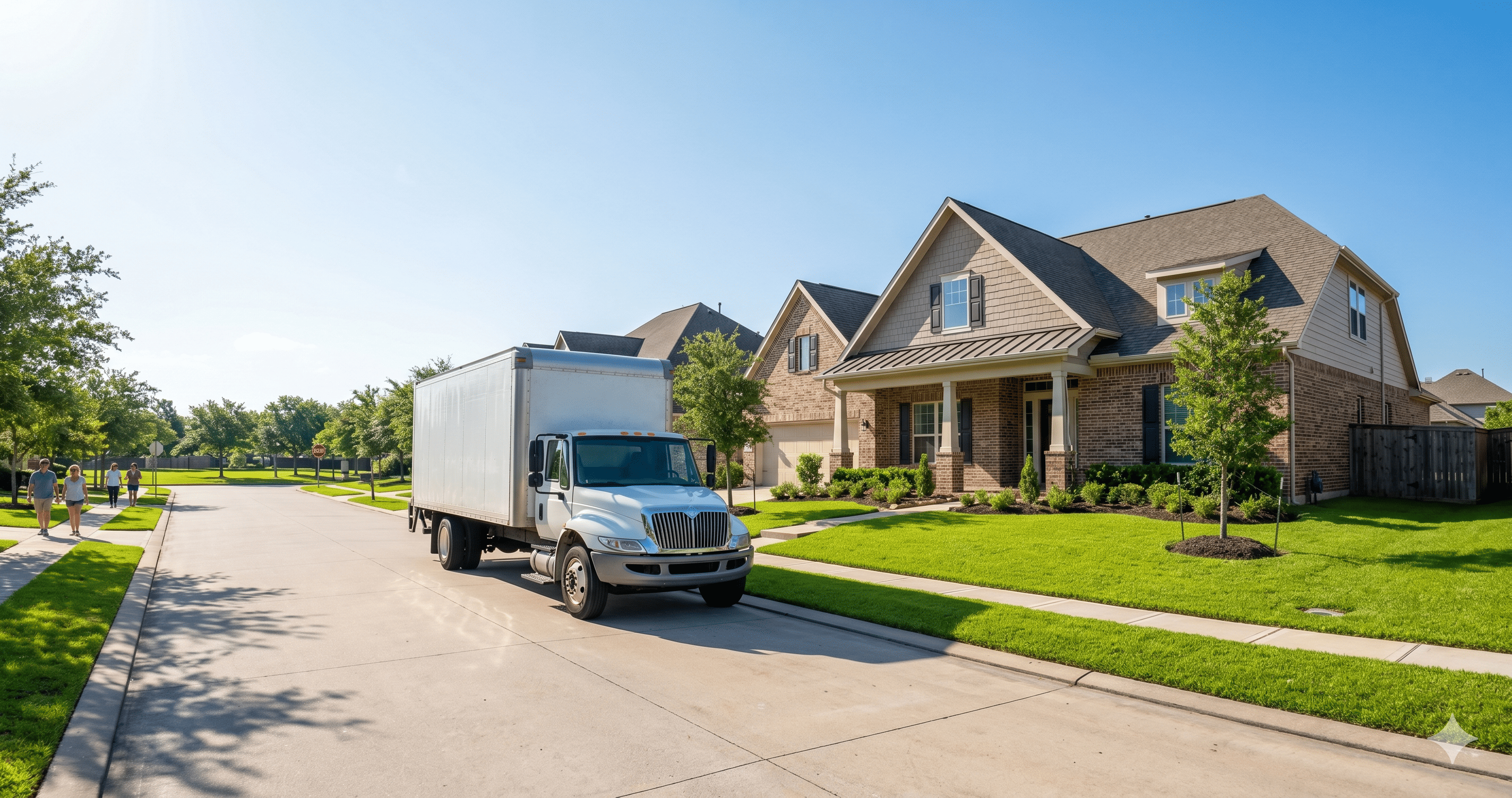
League City is one of the fastest-growing cities in Texas — and it's not hard to see why. Located 25 miles southeast of downtown Houston along I-45, it offers easy access to major employment hubs (NASA Johnson Space Center, the Texas Medical Center, and the Houston Ship Channel), excellent schools, low crime, and waterfront lifestyle options that few suburbs can match.
Getting Here: Major Employers & Commutes
| Destination |
Distance |
Avg. Drive (Off-Peak) |
Avg. Drive (Rush Hour) |
| NASA Johnson Space Center |
12 miles |
18 min |
30 min |
| Texas Medical Center |
28 miles |
35 min |
55–70 min |
| Downtown Houston |
30 miles |
38 min |
55–75 min |
| Galveston Island |
22 miles |
28 min |
35 min |
| Houston Hobby Airport |
20 miles |
25 min |
40 min |
| George Bush Intercontinental |
50 miles |
55 min |
80–90 min |
Schools: Clear Creek ISD
Every neighborhood in League City feeds into Clear Creek Independent School District (CCISD), one of the highest-rated large districts in Texas. CCISD serves approximately 41,000 students across Galveston and Harris counties. TEA rated the district "A" (Exemplary) in its most recent accountability report.
| High School |
TEA Rating |
SAT Avg. |
AP Courses |
Serves |
| Clear Falls High School |
A |
1,140 |
28 |
Tuscan Lakes, Westover Park |
| League City Collegiate High |
A |
1,210 |
35+ |
Early College |
| Clear Creek High School |
A |
1,090 |
22 |
South Shore, Bay Colony |
| Clear Springs High School |
B+ |
1,060 |
20 |
Heritage Park, Brittany Lakes |
Flood Zones & Insurance
This is the single most important due-diligence item for any League City buyer. Parts of League City experienced flooding during Hurricane Harvey (2017), though the city has invested significantly in drainage improvements since. FEMA flood zone designations vary dramatically by neighborhood — some areas are Zone X (minimal risk) while others carry Zone AE (100-year floodplain) designations requiring mandatory flood insurance.
- Zone X (preferred): Most of Tuscan Lakes, Westover Park, Brittany Lakes — no mandatory flood insurance
- Zone AE: Areas nearest Clear Lake and Galveston Bay — flood insurance required by lenders, typically $800–$2,200/year
- Always request a flood elevation certificate and check the current FEMA flood map before making an offer
- Consider purchasing flood insurance regardless of zone designation — post-Harvey, many Zone X properties flooded
Moving Checklist: Before You Arrive
- Obtain a Texas driver's license within 90 days of establishing residency (DPS office in Friendswood or Webster)
- Register your vehicle with the Galveston County Tax Assessor within 30 days
- File for homestead exemption with Galveston CAD — deadline is April 30 for the current tax year
- Set up utilities: CenterPoint Energy (electricity/gas), City of League City (water/wastewater)
- Enroll children in CCISD — open enrollment typically begins in February for the following school year
- Register to vote at the Galveston County Elections Office if relocating from out of state
Lisa Marie's Take
"File your homestead exemption the moment you close — don't wait. I've seen buyers lose thousands of dollars in savings because they missed the April 30 deadline. I send all my clients a reminder as part of my post-close follow-up."
Pros of Moving to League City
- No Texas state income tax
- Top-rated CCISD schools
- 15 min from NASA JSC
- Waterfront lifestyle options
- Strong job market (energy, aerospace, medical)
- Lower crime than Houston proper
Cons to Consider
- Higher property taxes than national avg.
- Flood risk in some areas
- Car-dependent — limited public transit
- Houston rush-hour commutes can be brutal
- Hot, humid summers (Jun–Sep)
- Hurricane season prep required
04
Waterfront Buyer's Guide
Waterfront Homes on Galveston Bay — League City Buyer's Guide
By Lisa Marie Sanders · March 2026 · 9 min read
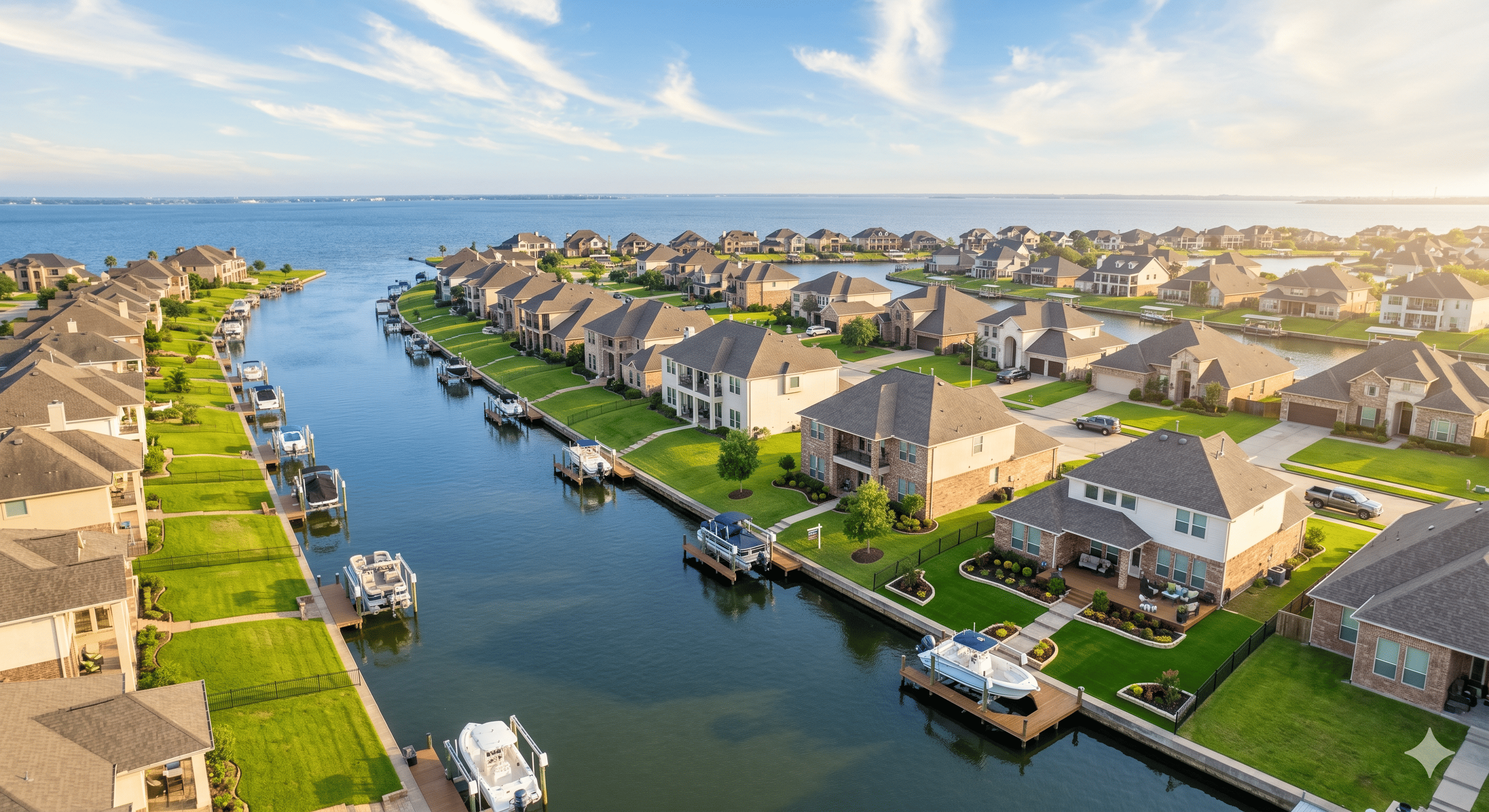
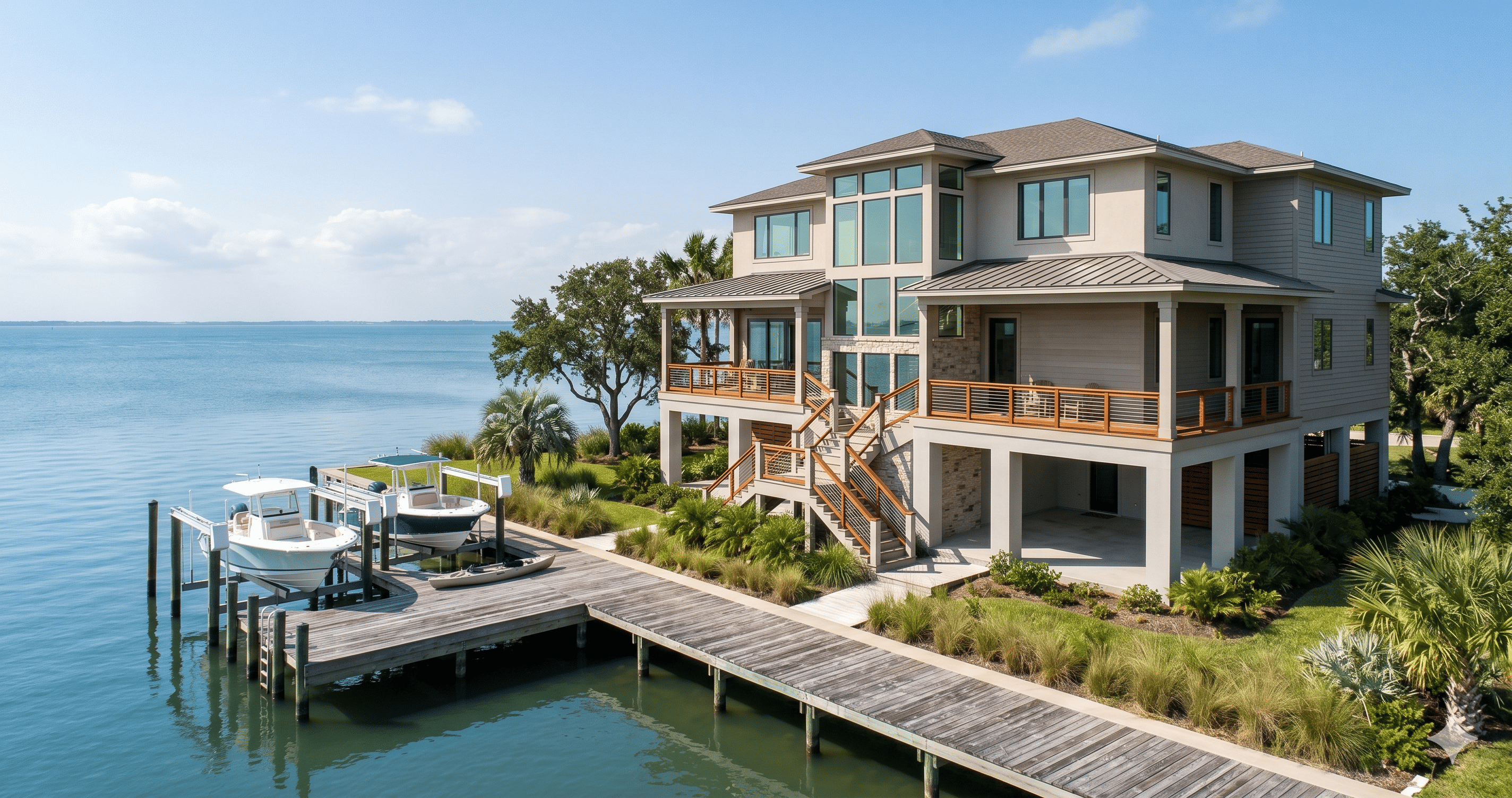
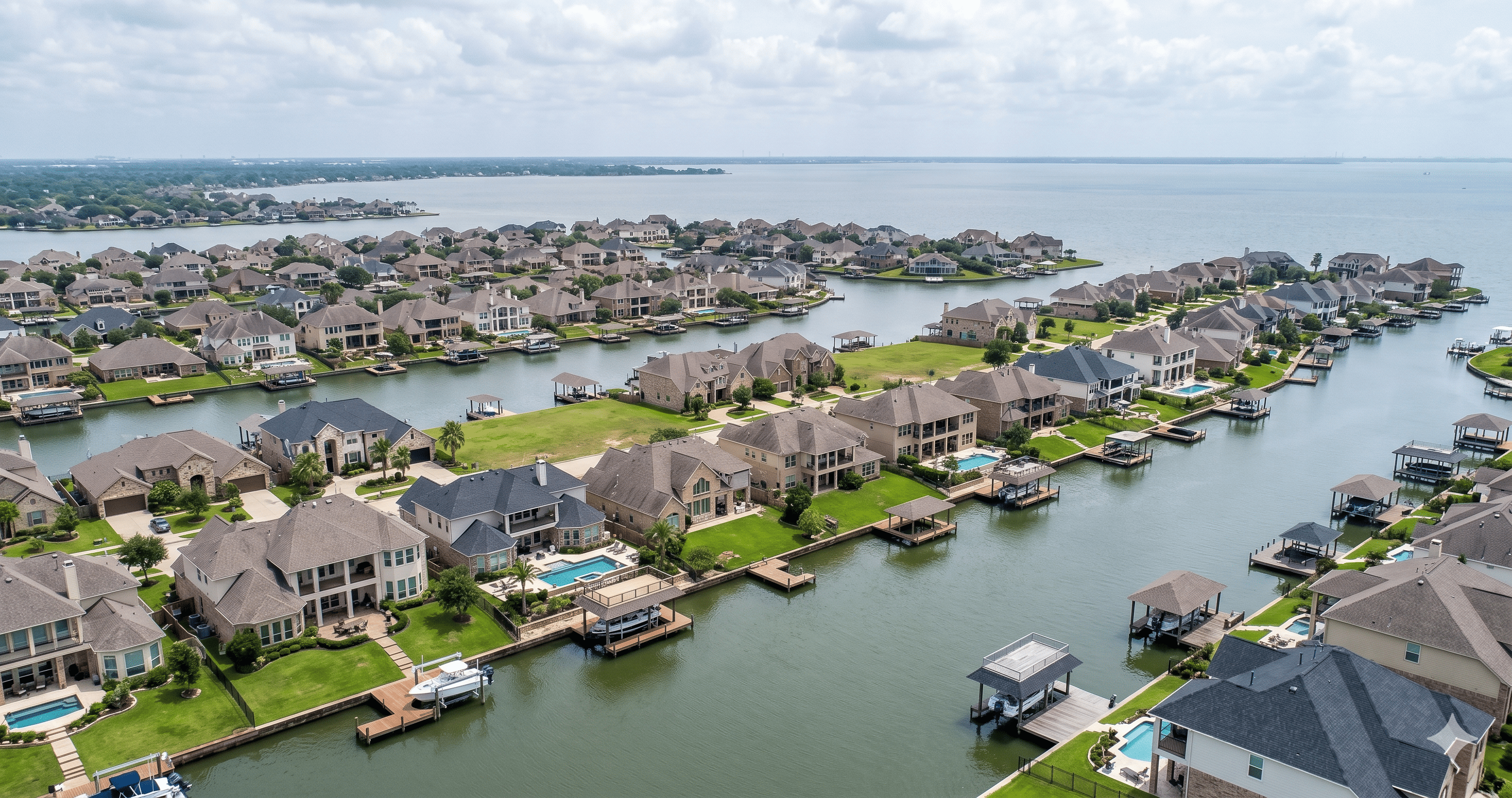
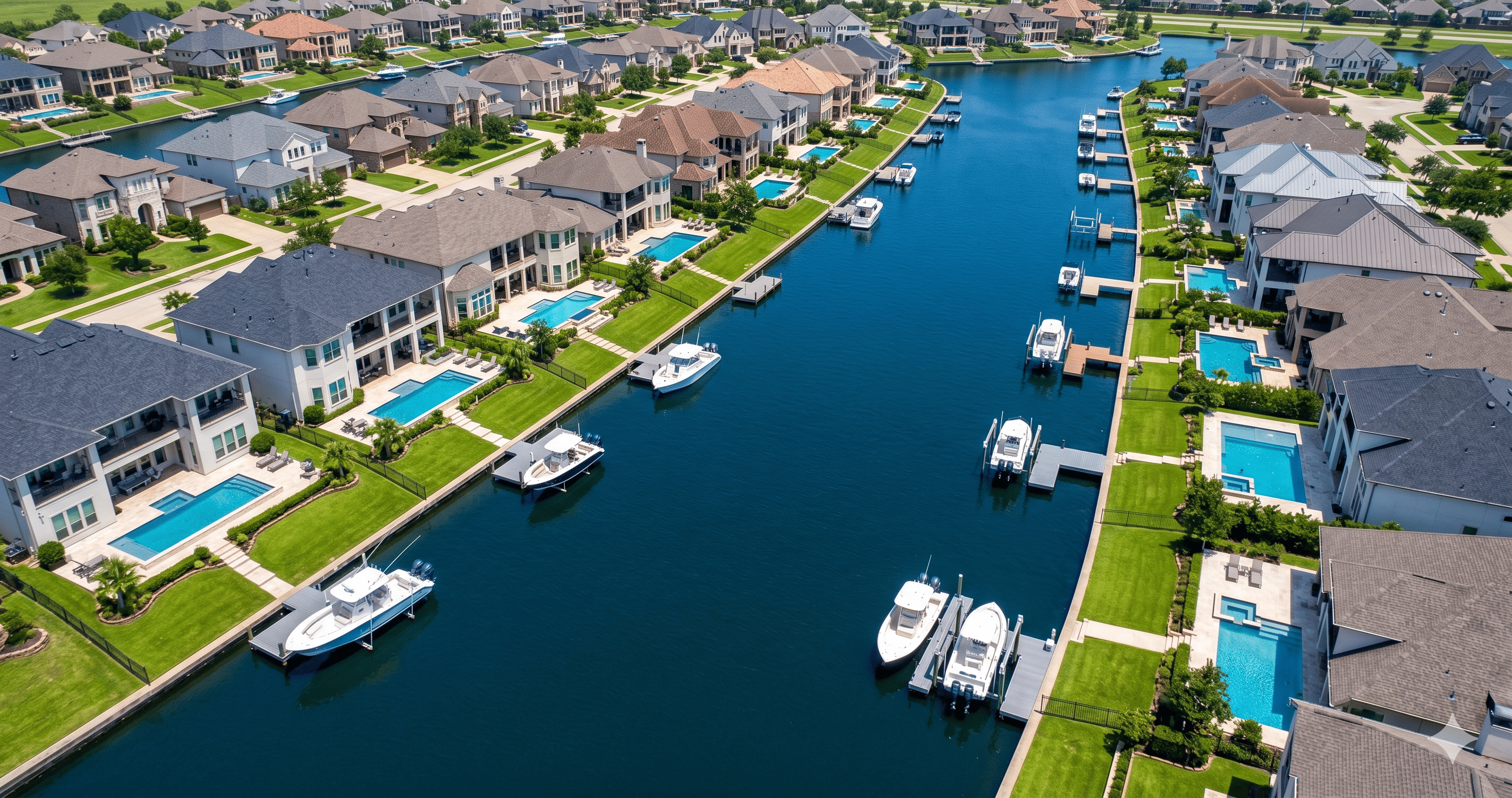
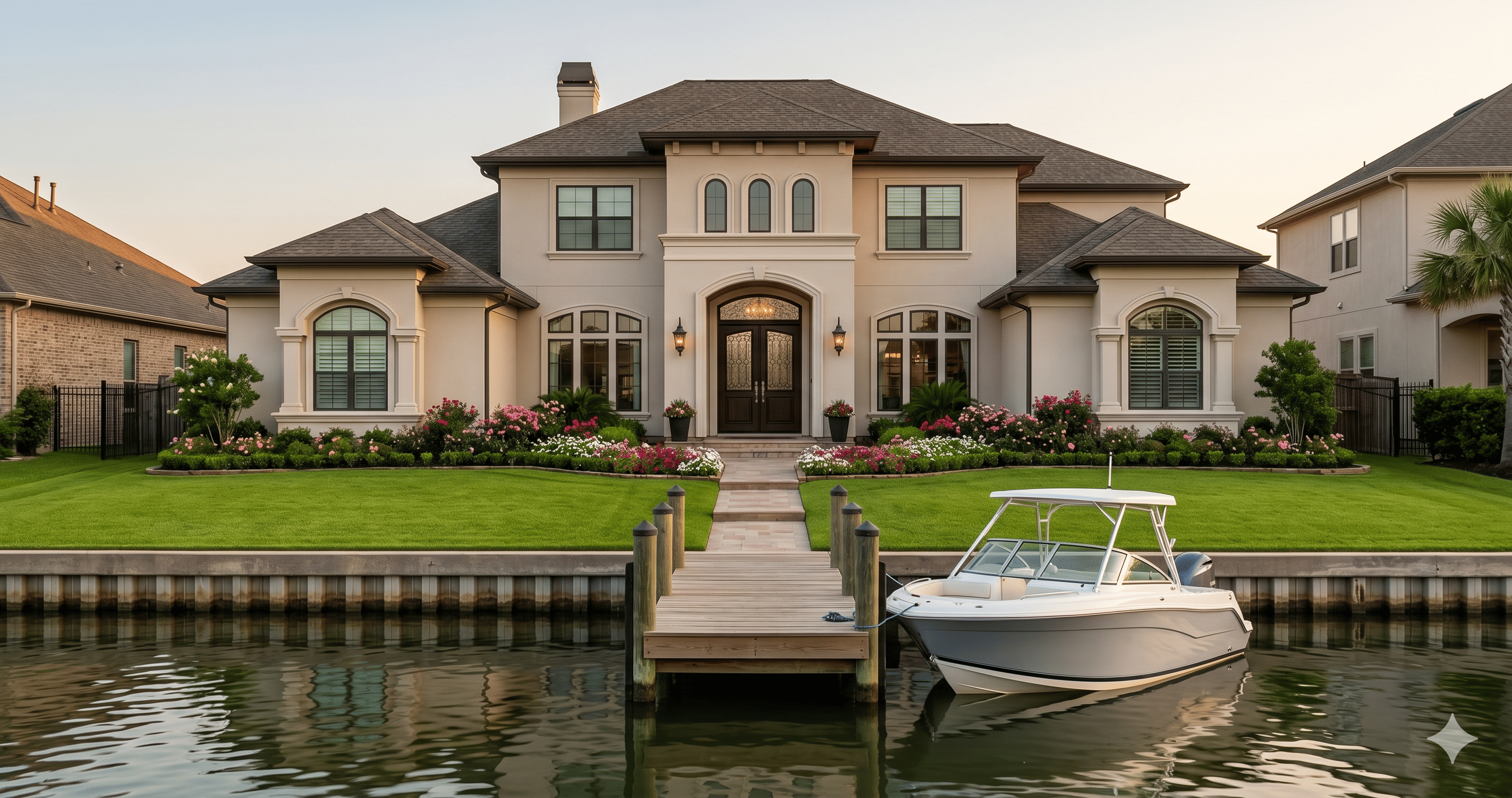
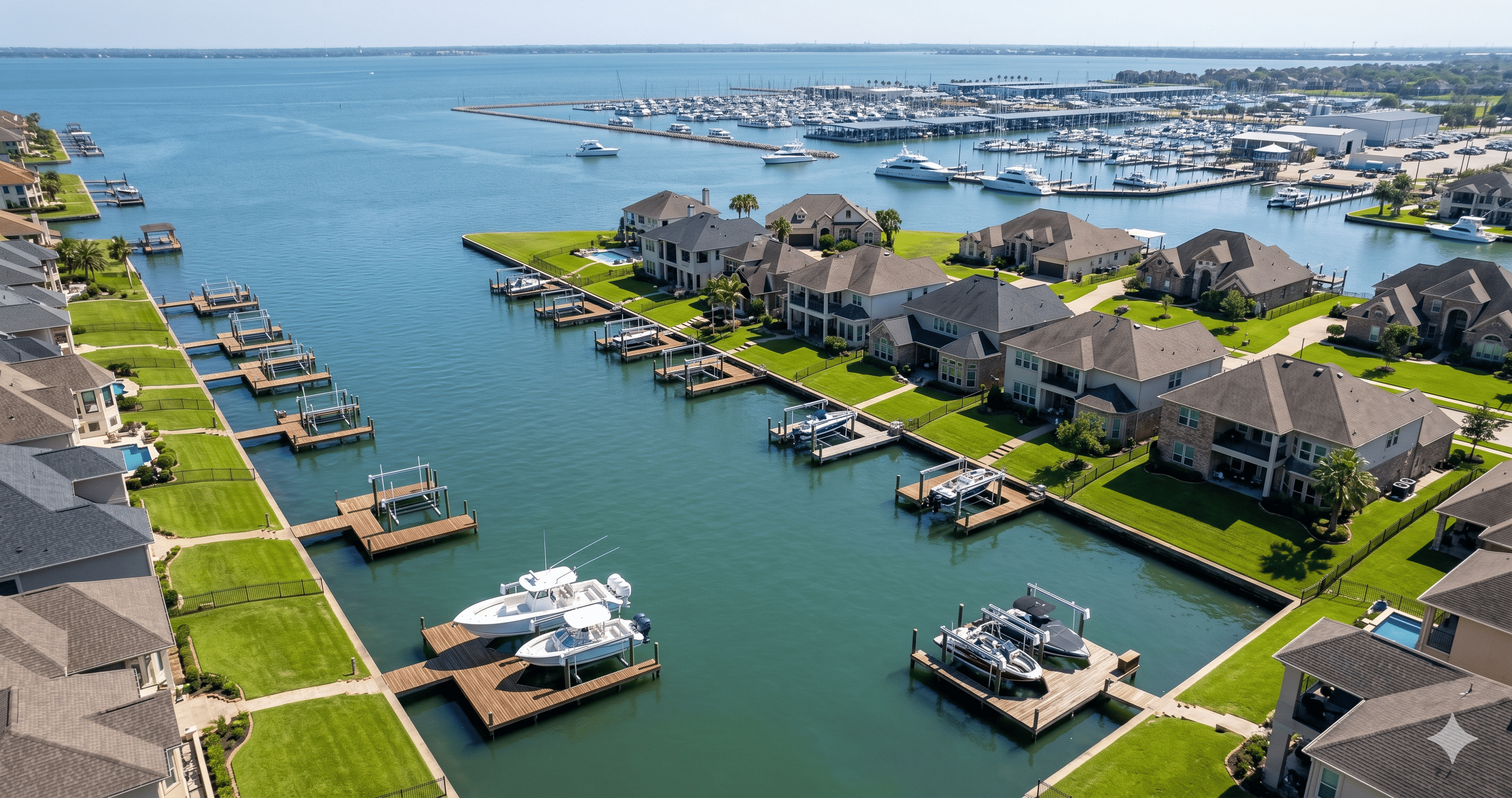
The League City area sits at the convergence of Clear Lake, Clear Creek, and Galveston Bay — a network of waterways that makes it one of the most accessible boating and waterfront living destinations in the entire Gulf Coast. For buyers who want both water access and proximity to Houston, this stretch of the Bay Area is genuinely hard to beat.
Waterfront Community Price Guide
| Community |
Waterfront Type |
Price Range |
Boat Access |
Flood Zone |
| South Shore Harbour |
Clear Lake / Marina |
$420K–$1.2M |
Marina slips |
AE / X |
| Landing at Bay Pointe |
Galveston Bay |
$550K–$2.5M |
Private docks |
AE |
| Bay Colony |
Clear Lake |
$380K–$900K |
Private / community ramp |
AE / X |
| Waterford Harbor |
Clear Creek |
$420K–$780K |
Private docks |
AE |
| Seabrook (adjacent) |
Galveston Bay |
$350K–$1.4M |
Marina / private docks |
AE / VE |
| Nassau Bay |
Clear Lake |
$480K–$950K |
Private docks |
AE |
What to Know Before You Buy Waterfront
Waterfront homes in this area carry a significant premium — typically 25–45% above comparable non-waterfront homes in the same community. That premium is real, but so are the additional carrying costs. Here's what buyers consistently underestimate:
- Flood insurance: Virtually all true waterfront parcels are Zone AE. Budget $1,200–$3,500/year for NFIP flood insurance, or explore private flood alternatives which can be more competitive for higher-value homes.
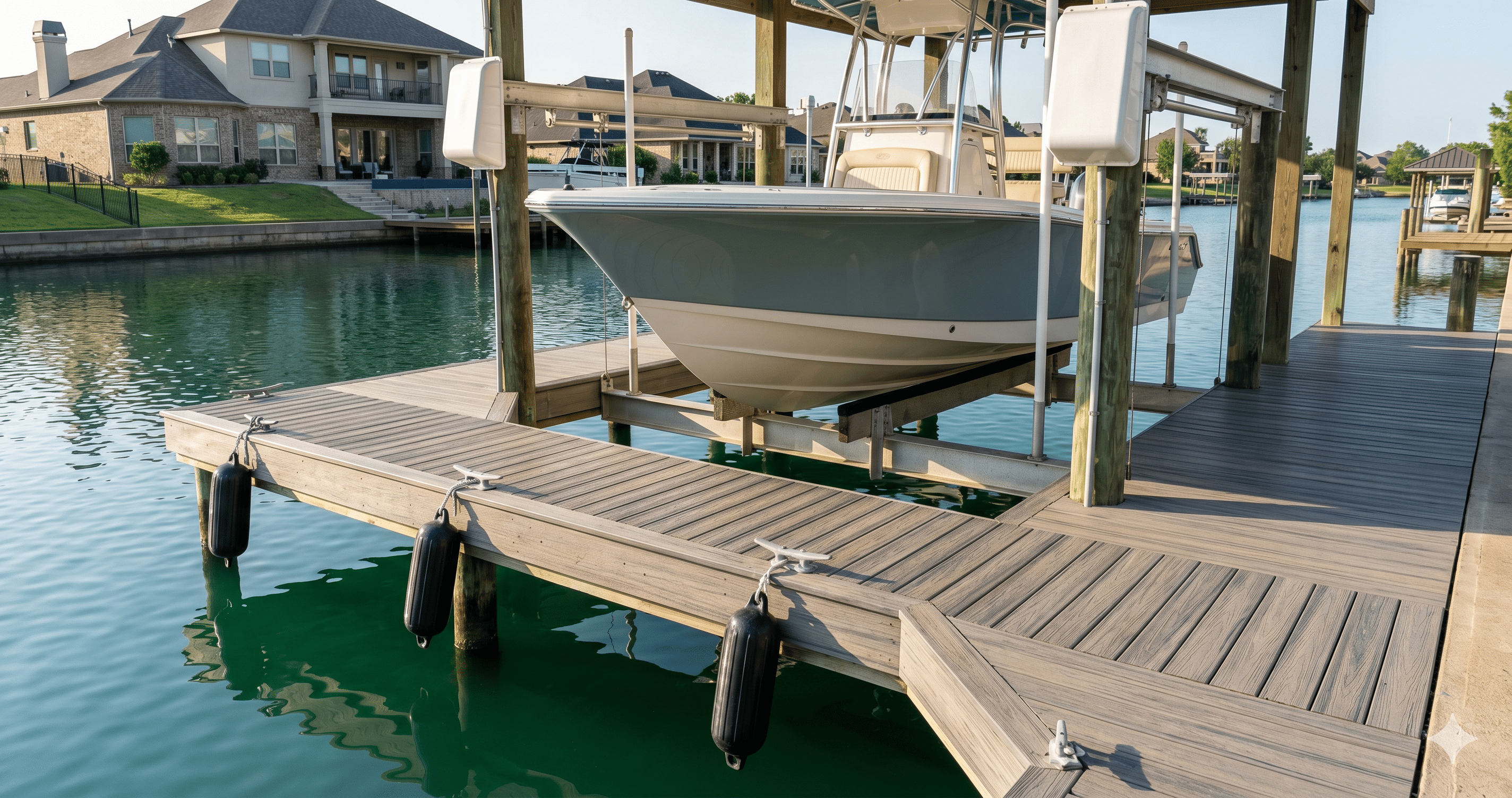
- Dock maintenance: A wood dock typically requires $2,000–$5,000 in maintenance every 5–7 years. Composite or aluminum docks cost more upfront but significantly less long-term.
- Bulkhead condition: Always have a marine contractor inspect the bulkhead (seawall). Replacement costs range from $200–$400/linear foot — on a 60-foot waterfront lot, that's $12,000–$24,000.
- HOA rules on boat size: Many Clear Lake communities restrict vessel length or prohibit certain hull types. Verify before you buy if you have a specific boat in mind.
- Wind insurance: Properties within Galveston County require a separate windstorm policy through the Texas Windstorm Insurance Association (TWIA). Budget $2,000–$8,000/year depending on coverage and construction.
Waterfront vs. Water-Access vs. Water-View
Not all "waterfront" listings are equal. Here's how to decode listing descriptions:
| Designation | What It Means | Typical Premium |
| True Waterfront |
Property line touches the water; private dock possible |
+30–50% |
| Water Access |
Community boat ramp or shared dock; no private frontage |
+8–15% |
| Water View |
Views of water but no access from the property |
+5–12% |
| Canal Front |
Fronts a canal feeding into a larger body; varies by depth |
+15–30% |
Lisa Marie's Take
"Canal-front homes are often the best value in the area — you get private dock access and a waterfront lifestyle at 15–20% less than open bay frontage. I always walk buyers through the navigable depth before we even look at the kitchen."
05
Quality of Life Review
Is League City a Good Place to Live? Honest 2026 Review
By Lisa Marie Sanders · March 2026 · 6 min read
League City was named one of Money Magazine's "Best Places to Live" and ranks consistently in the top 10 safest cities in Texas. But rankings don't tell the whole story. As someone who works with buyers throughout the Houston metro every day, here's my honest, unvarnished take.
The Numbers
| Metric |
League City |
Texas Avg. |
National Avg. |
| Population (2025 est.) |
120,000+ |
— |
— |
| Violent Crime Rate (per 100K) |
128 |
447 |
380 |
| Property Crime Rate (per 100K) |
1,420 |
2,510 |
1,960 |
| Median Household Income |
$98,400 |
$64,000 |
$74,000 |
| Unemployment Rate (2026) |
3.4% |
3.9% |
3.7% |
| Walk Score |
24 (Car-Dependent) |
— |
— |
| School District Rating |
A (CCISD) |
B avg. |
— |
What Residents Love
Safety is the most commonly cited reason people choose and stay in League City. The violent crime rate is roughly 66% below the Texas state average — a remarkable figure for a city of 120,000. Combined with CCISD's strong academic performance, this makes League City one of the premier family destinations in the entire Houston metro.
The waterfront lifestyle is a genuine differentiator. Few Houston suburbs give you the ability to keep a boat in your backyard and be 30 minutes from a major medical center or NASA. For aerospace professionals, energy sector employees, and medical workers, the location-lifestyle balance is hard to match.
The dining and entertainment scene has matured significantly in the past decade. The League City Historic District along Main Street has developed a collection of locally-owned restaurants, bars, and boutiques. The proximity to Kemah Boardwalk (5 miles) and Galveston Island (22 miles) adds significant recreational depth.
Honest Drawbacks
No city is perfect, and League City has genuine drawbacks that buyers should weigh honestly:
- Car dependency is total. Walk Score of 24 means you will drive everywhere, every time. There is no meaningful public transit. If you're relocating from a walkable urban environment, this is a real lifestyle adjustment.
- Houston rush hour is real. The I-45 corridor to downtown Houston is one of the most congested in the state during peak hours. If your office is downtown and remote work isn't an option, budget 55–75 minutes each way in morning/evening rush.
- Flood risk requires vigilance. While most of League City's established neighborhoods fared well in Harvey, flood risk is a reality of Gulf Coast living. Due diligence on flood zone, elevation, and insurance is non-negotiable.
- Summer heat is extreme. June through September brings temperatures regularly above 95°F with high humidity. Utility bills spike accordingly, and outdoor activities are best before 9am or after 7pm.
Best For
- Families with school-age children
- NASA / aerospace professionals
- Medical center commuters
- Boating & waterfront enthusiasts
- Remote workers seeking value
- Retirees downsizing from larger cities
May Not Suit
- Urban walkability seekers
- Public transit dependent commuters
- Downtown Houston daily commuters
- Those averse to Gulf Coast weather
- Buyers with very tight flood insurance budgets
Lisa Marie's Verdict
"League City earns its reputation. For the right buyer — especially families, NASA-area professionals, and anyone who wants waterfront access without paying Galveston Island prices — it's genuinely one of the best value propositions in the Houston metro. The key is buying in the right flood zone, which is exactly where working with an experienced local agent pays for itself."
Sources
FBI Uniform Crime Reporting (UCR) 2024 · Texas Education Agency (TEA) 2025 Accountability Ratings · U.S. Census Bureau ACS 2024 · Walk Score · HAR Q1 2026 · FEMA Flood Map Service Center · Texas Comptroller
06
2026 Review
Is League City, Texas a Good Place to Live in 2026?
By Lisa Marie Sanders · March 2026 · 7 min read
Yes — League City is one of the best places to live in Greater Houston in 2026. It offers a rare combination of top-rated schools, low crime, waterfront access, and home prices that remain attainable compared to most major metros. For families, young professionals, and NASA-area employees in particular, it consistently outperforms alternatives on almost every livability metric.
Why 2026 Is a Strong Year to Consider League City
The Houston Bay Area job market is expanding. The Johnson Space Center continues to grow its contractor workforce, and the petrochemical and maritime industries along the Ship Channel remain robust. League City benefits directly — it's the closest sizable residential community to JSC, and its housing stock has expanded significantly with new master-planned communities adding inventory at multiple price points.
Home prices have stabilized after the 2021–2023 run-up. The median sits around $340,000–$390,000, giving buyers reasonable value without the panic-buying conditions of recent years. Interest rates remain elevated nationally, but League City's price point means monthly payments are still manageable relative to comparable cities in other states.
Schools in 2026
Clear Creek ISD (CCISD) continues to earn strong TEA accountability ratings. Several elementary and middle schools in the district score 8–9/10 on GreatSchools. Clear Creek High School and Clear Springs High School are both well-regarded for academics, athletics, and college placement. For 2026, CCISD has no major redistricting planned — boundaries are stable, which matters when you're buying for school access.
Livability Snapshot — 2026
| Category | League City Rating | Texas Average |
| Violent Crime Rate | ✅ Well Below Average | Average |
| School Quality (CCISD) | ✅ Above Average | Average |
| Cost of Living | ✅ 8% Below TX Metro Avg | Baseline |
| Commute to Houston | ⚠️ 30–45 min (I-45) | Varies |
| Flood Risk | ⚠️ Zone-Dependent | Varies |
| Waterfront Access | ✅ Excellent (Clear Lake/Bay) | Limited |
| New Construction | ✅ Active | Varies |
Who League City Is Best For in 2026
- NASA / JSC employees and contractors — the commute is 10–15 minutes
- Families with school-age children — CCISD is one of the most consistent districts in the state
- Boating and outdoor enthusiasts — Clear Lake and Galveston Bay are literally in the backyard
- California and Northeast relocators — the cost differential is dramatic and immediate
- Remote workers — more house for your dollar, and Houston's airport connectivity is excellent for travel days
Bottom Line
League City in 2026 is not a hidden gem anymore — but it hasn't been overpriced either. If you want a well-run city with good schools, real water access, and a genuine community feel within striking distance of one of America's great cities, it belongs at the top of your list.
07
Relocation Guide
Moving to League City TX: Complete Relocation Guide
By Lisa Marie Sanders · March 2026 · 11 min read
Moving to League City, TX is a straightforward and rewarding relocation for most buyers. The city is well-organized, family-oriented, and significantly more affordable than comparable communities in coastal metros. The key decisions to make upfront are flood zone, school boundary, and commute corridor — get those three right and you'll land in exactly the right neighborhood.
Step 1: Understand the Geography
League City sits in Galveston County, approximately 25 miles southeast of downtown Houston on I-45. It borders Clear Lake to the north (NASA/JSC territory), Friendswood to the west, and has extensive frontage on Galveston Bay to the east. The city covers about 54 square miles and is bisected by I-45 and Highway 96 — knowing which side of the freeway you're on matters for commute times and neighborhood character.
Step 2: Choose Your Neighborhood Type
- Master-planned communities (South Shore, Tuscan Lakes, Hometown Heroes) — HOA amenities, newer construction, consistent values
- Waterfront communities (Harbour Park, Bay Forest, Westover Park) — canal or bay access, dock potential, flood zone awareness required
- Established neighborhoods (Heritage Park, Countryside) — mature trees, larger lots, often more negotiable pricing
- New construction (West League City growth corridor) — builder incentives, modern floor plans, longer commute to bay
Step 3: Understand CCISD School Boundaries
Clear Creek ISD serves virtually all of League City. The district has 11 elementary schools, 5 middle schools, and 4 high schools within or near the city. Boundaries matter — two homes one street apart can be zoned to different elementaries. Always verify the exact school assignment for any property you're considering, not just the general district. Lisa Marie verifies school boundaries on every transaction.
Step 4: Assess Flood Risk Before You Fall in Love
League City has areas in FEMA Zone X (minimal risk), Zone AE (high risk, flood insurance required), and everything in between. Post-Harvey investments in drainage have improved the situation citywide, but flood history on an individual property is still the most important disclosure to review. Ask specifically: has this home ever flooded? A property in Zone X with no flood history and good elevation is very different from one in Zone AE with a history of water intrusion.
Step 5: Plan Your Commute
| Destination | Distance | Drive (Off-Peak) | Drive (Peak) |
| NASA / Johnson Space Center | 8–12 mi | 15 min | 20 min |
| Texas Medical Center | 28 mi | 30 min | 45–55 min |
| Downtown Houston | 27 mi | 30 min | 45–60 min |
| Hobby Airport (HOU) | 18 mi | 20 min | 30 min |
| Galveston Island | 22 mi | 25 min | 35 min |
| Pearland | 15 mi | 20 min | 25 min |
Relocation Checklist
- ☐ Confirm CCISD school assignment for target address
- ☐ Pull FEMA flood map for property — check zone and elevation certificate
- ☐ Ask seller for flood history disclosure (required by Texas law)
- ☐ Register vehicle with Texas DMV within 30 days of move
- ☐ Apply for Texas homestead exemption (saves 15–20% on property taxes)
- ☐ Update voter registration to Galveston County
- ☐ Transfer utilities: CenterPoint Energy (gas/electric), City of League City (water)
- ☐ Get quotes on flood insurance if in Zone AE (budget $1,200–$3,000/yr)
Lisa Marie's Advice
"Most relocation mistakes in League City come down to one of three things: buying in the wrong flood zone without understanding the risk, not verifying the exact school assignment, or underestimating the I-45 peak-hour commute. Address all three before you make an offer, and you'll love it here."
08
Honest Review
Pros and Cons of Living in League City, TX
By Lisa Marie Sanders · March 2026 · 8 min read
League City is an excellent place to live for families and professionals — but it's not perfect for everyone. The pros are real: great schools, low crime, waterfront access, and genuine affordability. The cons are also real: summer heat, car dependency, flood risk in parts of the city, and a commute that can grind during peak hours. Here's the unfiltered breakdown.
✅ The Pros
Top-Rated Schools
Clear Creek ISD is among the most consistently strong districts in the Houston area. Multiple campuses earn 8–9/10 ratings, and the district offers robust AP, IB, and CTE programs. For families, this is frequently the deciding factor — and it holds up year after year.
Low Crime Rate
League City's violent crime rate is significantly below both state and national averages. It regularly appears on Texas "safest cities" lists. The police department is well-funded and visible, and master-planned communities add another layer of safety infrastructure through HOA-managed access and lighting.
Waterfront Access
Very few suburbs of any major city give residents direct access to boating, fishing, and waterfront dining the way League City does. Clear Lake connects to Galveston Bay and the Gulf Intracoastal Waterway. If you own a boat — or want to — this is a rare lifestyle advantage baked into the geography.
Affordability vs. Coastal Markets
A household budget that buys a 1,400 sq ft condo in San Diego or a townhome in Seattle buys a 3,000+ sq ft home with a pool in League City. No state income tax amplifies the advantage further. For relocators from high-cost states, the financial whiplash is immediate and significant.
Strong Job Market Proximity
NASA's Johnson Space Center is 10–15 minutes away. The Texas Medical Center — the largest medical complex in the world — is 30 minutes. The Ship Channel petrochemical corridor is accessible without crossing downtown. League City punches above its weight for employment proximity.
⚠️ The Cons
Summer Heat and Humidity
June through September in League City is genuinely brutal. Temperatures regularly exceed 95°F and the Gulf humidity makes it feel hotter. Air conditioning is not optional — it's infrastructure. If you're moving from a temperate climate, allow a full summer to acclimate before you decide how you feel about it.
Car Dependency
League City has a Walk Score of around 30 — car-dependent. There is no commuter rail to Houston. Public transit is minimal. You will drive everywhere, and the I-45 corridor can be punishing during morning and evening rush hours, especially between League City and the Medical Center or downtown.
Flood Risk (Zone-Dependent)
Not all of League City floods — but some of it does, and post-Harvey anxiety is real among buyers. Properties in FEMA Zone AE require flood insurance (typically $1,200–$3,000/year) and carry real risk of water intrusion in major storm events. This is manageable with the right property selection, but it requires due diligence and can't be dismissed.
Property Taxes
Texas property taxes are among the highest in the nation, running 2.2%–2.6% of assessed value in League City. On a $400,000 home, that's $8,800–$10,400 per year. The homestead exemption helps, but this is a real carrying cost that catches some buyers off guard after relocating from low-property-tax states.
Limited Walkable Urban Culture
League City is suburban in character. There is no dense walkable downtown with independent restaurants, live music venues, or street life. For that, you go to Houston. If urban culture is important to your daily quality of life, you'll want to be honest about how much you'll miss it — and how often you'll make the drive.
The Honest Summary
For families and professionals who value schools, safety, space, and outdoor access over urban walkability, League City is genuinely hard to beat in the Houston metro. The cons are real but manageable — especially with the right guidance on flood zones and neighborhood selection.
09
Suburb Comparison
League City vs Friendswood: Which Houston Suburb Is Better?
By Lisa Marie Sanders · March 2026 · 8 min read
Both League City and Friendswood are excellent suburbs — but they suit different buyers. Friendswood offers a smaller, tighter-knit community with a slightly quieter character and strong CCISD schools. League City is larger, offers more housing variety, and has a unique advantage: direct access to Clear Lake and Galveston Bay waterfront. The right choice depends on your lifestyle priorities.
Side-by-Side Comparison
| Category | League City | Friendswood |
| Population | ~115,000 | ~42,000 |
| Median Home Price | $340,000–$390,000 | $360,000–$420,000 |
| School District | CCISD | FISD / CCISD (split) |
| Waterfront Access | ✅ Yes — Clear Lake & Bay | ❌ Limited |
| New Construction | ✅ Abundant | ⚠️ Limited inventory |
| Commute to Houston | 30–45 min (I-45) | 25–40 min (I-45/518) |
| Crime Rate | ✅ Low | ✅ Very Low |
| City Character | Growing suburban city | Quiet established community |
| HOA Communities | Many options | Fewer, more established |
| Dining & Retail | More variety | More limited |
Schools: CCISD vs FISD
Most of League City falls under Clear Creek ISD (CCISD), which is consistently strong. Friendswood is split — the southern portion falls under Friendswood ISD (FISD), which is smaller and tightly focused, with Friendswood High School frequently earning recognition as one of the best in Texas. If attending Friendswood ISD is a priority, verify the specific address falls within that district — a meaningful portion of Friendswood's geography is actually CCISD-zoned.
Waterfront: League City Wins Clearly
If boating, fishing, or waterfront living is part of why you're considering the Bay Area, League City is the obvious choice. Friendswood is inland — it borders Galveston Bay only very marginally and has no meaningful waterfront residential market. League City's communities along Clear Lake and the bay offer an entirely different lifestyle tier.
Price and Inventory
League City has more housing variety at more price points. Friendswood's desirability and limited new construction have pushed prices slightly higher per square foot in comparable neighborhoods. If you want more home for your money or prefer new construction, League City has more options. If you want an established neighborhood with mature trees and a quieter feel, Friendswood's older sections deliver that more consistently.
Who Should Choose Each
- Choose League City if: you want waterfront access, more new construction choices, a larger city feel, or proximity to JSC
- Choose Friendswood if: you prize a quieter, more small-town atmosphere, want Friendswood ISD specifically, or prefer an established neighborhood with mature landscaping
Lisa Marie's Take
"I work extensively in both cities and genuinely love them both. The decision usually comes down to one thing: water. If you want to be on the lake or bay, League City. If you want the absolute quietest, most established suburban feel, Friendswood. Either way, you're getting great schools and low crime — the fundamentals are strong in both."
10
Houston Suburbs Guide
Best Suburbs Near Houston for Families in 2026
By Lisa Marie Sanders · March 2026 · 9 min read
The best Houston suburbs for families in 2026 are Katy, Sugar Land, The Woodlands, League City, and Friendswood — each offering top-rated schools, low crime, and strong community infrastructure. The right choice depends on which part of Houston you're working near, your budget, and whether waterfront access or urban proximity matters to you.
The Top 6 Houston Family Suburbs — Ranked and Compared
| Suburb | School District | Median Price | Best For |
| Katy | Katy ISD (#1 in TX) | $320K–$480K | Top schools, master-planned living |
| Sugar Land | Fort Bend ISD | $350K–$600K | Diverse community, upscale amenities |
| The Woodlands | Conroe ISD / CISD | $400K–$900K+ | Luxury, nature, corporate campuses |
| League City | Clear Creek ISD | $340K–$390K | Waterfront access, NASA proximity |
| Friendswood | FISD / CCISD | $360K–$420K | Small-town feel, very low crime |
| Pearland | Pearland ISD / AISD | $280K–$400K | Affordability, Medical Center commute |
Katy, TX — Best for School Rankings
Katy ISD is consistently ranked the #1 school district in Texas by multiple metrics. If school quality is your primary filter, Katy belongs at the top of your list. The trade-off is distance — Katy is on the west side of Houston, making it a long commute to the Medical Center, downtown, or the Bay Area. It is ideal for Energy Corridor and I-10 corridor workers.
Sugar Land — Best for Upscale Suburban Living
Sugar Land (Fort Bend County) is polished, well-planned, and diverse. Fort Bend ISD is excellent, and the city's First Colony and Riverstone master-planned communities set a high bar for amenities. Prices are slightly higher than League City, but the community infrastructure justifies the premium for many buyers.
The Woodlands — Best for Luxury Buyers
The Woodlands is in a category of its own — a full master-planned community with its own town center, performing arts venue, and corporate campus park. Home prices reflect the prestige. It's ideal for buyers in the $500K+ range who want the most complete suburban environment in the Houston metro.
League City — Best for Waterfront + Good Schools
No other top Houston family suburb offers what League City does: strong schools, low crime, and direct access to boating waters. For NASA employees, Bay Area industry workers, or families who want a boat in the backyard without sacrificing school quality, League City is uniquely positioned.
Pearland — Best for Affordability Near the Medical Center
Pearland offers the best price-per-square-foot among strong Houston suburbs. It's the preferred destination for nurses, doctors, and researchers at the Texas Medical Center who can't afford Sugar Land prices. Pearland ISD has been improving steadily, though it doesn't yet match Katy or CCISD for overall rankings.
How to Choose
Map your primary workplace first, then filter by school district. The Houston metro is large enough that choosing the wrong side of the city can cost you 30–45 minutes per commute day. Get the geography right, and every suburb on this list will serve your family well.
11
Cost of Living
Cost of Living in League City, Texas — Full 2026 Breakdown
By Lisa Marie Sanders · March 2026 · 7 min read
League City's cost of living runs approximately 8–12% below the national average and 35–45% below major coastal metros like Los Angeles, Seattle, or Boston. Housing is the primary driver of savings, amplified by Texas's zero state income tax. Day-to-day costs like groceries, healthcare, and utilities are close to the national average.
Housing Costs
| Home Type | Price Range | Est. Monthly Payment* |
| Entry-level (3/2, ~1,600 sqft) | $230,000–$290,000 | $1,550–$1,950 |
| Move-up (4/3, ~2,400 sqft) | $320,000–$420,000 | $2,150–$2,850 |
| Luxury (4–5 bed, ~3,500 sqft) | $480,000–$700,000 | $3,200–$4,700 |
| Waterfront / Bay-front | $550,000–$1.5M+ | $3,700–$10,000+ |
*Estimated at 7% 30-year fixed, 10% down, includes taxes and insurance. Not a loan commitment.
Property Taxes
Property taxes in League City (Galveston County) run approximately 2.2%–2.6% of assessed value annually. On a $380,000 home, expect $8,360–$9,880 per year, or roughly $700–$820/month included in your mortgage payment. The Texas homestead exemption reduces your taxable value by $100,000 for school taxes — a meaningful offset that every primary resident should file.
Utilities
Monthly utility costs in League City average $180–$260 for a mid-size home. Summer electricity bills spike due to air conditioning demand — budget $250–$350 in June–September. CenterPoint Energy serves the area for gas and electricity. Internet (fiber availability is expanding) runs $60–$100/month through Comcast, AT&T, or local providers.
Everyday Expenses vs. Comparable Cities
| Expense | League City | Los Angeles | Austin | Denver |
| Median Home Price | $360K | $870K | $530K | $580K |
| State Income Tax | $0 | Up to 13.3% | $0 | 4.4% |
| Groceries (index) | 97 | 110 | 98 | 105 |
| Healthcare (index) | 95 | 108 | 96 | 102 |
| Utilities (index) | 103 | 115 | 99 | 97 |
| Dining Out (avg meal) | $15–$22 | $22–$35 | $17–$28 | $18–$30 |
The Bottom Line
For buyers relocating from high-cost states, the League City math is transformative. Zero state income tax, housing costs 40–60% lower than coastal metros, and a competitive job market mean most households materially improve their financial position within the first year of the move.
12
Buyer's Prep Guide
What to Know Before Moving to League City, TX
By Lisa Marie Sanders · March 2026 · 8 min read
The three things most buyers wish they'd known before moving to League City are: how flood zones actually work here, how dramatically property taxes affect monthly payments, and how much I-45 traffic varies by the time of day. Get clear on all three before you sign a contract and the transition will be smooth.
1. Flood Zones Are Not All Equal — And They Change
League City has properties in Zone X (low risk), Zone AE (high risk), and transitional zones. Two homes two blocks apart can be in different FEMA zones. Always request the flood zone designation and elevation certificate before making an offer. Post-Harvey, the city has invested heavily in drainage infrastructure, and some properties have been remapped to lower-risk zones — but some haven't. Don't assume.
Flood insurance in Zone AE typically costs $1,200–$3,000 per year through the NFIP or private carriers. Factor this into your monthly payment calculations before falling in love with a price point.
2. Property Taxes Will Surprise You
If you're coming from a state with low property taxes (Florida, Nevada, Washington), Texas's 2.2%–2.6% annual rate will be a genuine shock. On a $400,000 home, that's $8,800–$10,400 per year — roughly $733–$867 added to your monthly payment before principal, interest, or homeowner's insurance. File your homestead exemption the first year — it reduces taxable value significantly and caps annual increases at 10%.
3. I-45 Is Not Always 30 Minutes
The commonly cited "30 minutes to Houston" figure is accurate at 10am on a Tuesday. During peak morning commute (7–9am) or afternoon return (4:30–6:30pm), that same trip can stretch to 45–65 minutes, especially if you're heading to the Medical Center or downtown rather than JSC. Spend a trial week commuting at your actual hours before locking in a neighborhood based on drive time assumptions.
4. Summer Is a Different Lifestyle
June through September means outdoor activities shift to early morning or evening. Pools are heavily used. Air conditioning bills spike. Social life migrates indoors. This isn't a deal-breaker — most residents adapt and genuinely love the winters (lows rarely below 40°F) — but if you're coming from the Pacific Northwest or the Rockies, give yourself a full summer before deciding how you feel.
5. HOA Rules Vary Dramatically
League City's master-planned communities have HOAs with real authority — and varying rules around fencing, landscaping, parking, short-term rentals, and exterior modifications. Read the CCRs before you close. Some HOAs have active architectural review committees; others are largely hands-off. If you care about parking an RV or running a home business, verify the specific HOA rules for your target community.
6. The Real Estate Market Moves Fast on Good Properties
Well-priced homes in desirable League City neighborhoods — particularly in Zone X flood areas with CCISD zoning — can attract multiple offers within days. If you're relocating from a slower market, adjust your expectations: pre-approval in hand and a clear understanding of what you want before you start touring will serve you well.
Lisa Marie's Advice
"The buyers who have the smoothest transitions to League City are the ones who did their homework on flood zones and property taxes before they fell in love with a specific house. I walk every client through both in our first conversation — because surprises at closing are the last thing anyone needs."
13
Safety Guide
Safest Neighborhoods in League City, TX
By Lisa Marie Sanders · March 2026 · 6 min read
League City as a whole is one of the safest cities in Texas — but some neighborhoods are particularly notable for low crime, strong HOA management, and a tight community feel. South Shore, Tuscan Lakes, Clear Creek Shores, and Bay Forest consistently stand out. Here's the neighborhood-level breakdown buyers ask me about most.
Why League City Is Safe Overall
League City's violent crime rate sits well below both Texas and national averages, consistently ranking in the top 10–15 safest cities in the state. The city benefits from a well-funded police department, active neighborhood watch programs in most HOA communities, and the demographic profile of a family-oriented, owner-occupied suburb with low transience.
Safest Neighborhoods by Reputation and Data
| Neighborhood | Character | Safety Notes | Price Range |
| Tuscan Lakes | Master-planned, newer | Gated sections, active HOA, very low incident reports | $380K–$600K |
| South Shore Harbour | Waterfront community | Marina access, strong HOA, established neighborhood watch | $350K–$800K+ |
| Bay Forest | Waterfront, established | Canal-front, quiet streets, strong community identity | $300K–$550K |
| Westover Park | Family suburban | Cul-de-sac layout, low through-traffic, family-heavy demographics | $280K–$420K |
| Clear Creek Shores | Waterfront enclave | Small, close-knit community, neighbors know neighbors | $350K–$700K |
| Hometown Heroes | Master-planned, newer | Community-focused development, active HOA enforcement | $290K–$430K |
What Makes a Neighborhood Safe Here
In League City, the safest neighborhoods share a few common traits: active HOA management (which keeps properties maintained and deters transience), owner-occupied rather than high-rental demographics, cul-de-sac or limited through-street layouts that reduce vehicle traffic, and strong neighborhood identity. These factors correlate with safety outcomes more reliably than any single data metric.
How to Verify Safety for a Specific Address
The League City PD publishes a crime map on the city website. NeighborhoodScout and CrimeGrade.org provide block-level data. For the most reliable picture, cross-reference multiple sources and look at trends over 2–3 years rather than a single snapshot. Lisa Marie provides hyperlocal safety context for every neighborhood she works in as a standard part of the buyer consultation.
A Note on Context
"When clients ask me about safety, I always start with the city-wide data — which is strong — and then go deeper into the specific block. A half-mile radius can look very different from a neighborhood-level average. That granularity is where local knowledge actually matters."
14
Coastal Living Guide
Best Houston Suburbs Near the Coast in 2026
By Lisa Marie Sanders · March 2026 · 7 min read
The best Houston suburbs near the coast are League City, Clear Lake, Friendswood, Kemah, and Seabrook — all within 30 minutes of Galveston Bay and 45 minutes of Galveston Island beaches. Each offers a different balance of price, water access, and community character. For buyers who want both suburban infrastructure and coastal lifestyle, this corridor is one of the most underrated in the country.
The Houston Bay Area Coastal Corridor
Unlike most major American cities, Houston's suburban development extends directly to the coast. The I-45 South corridor from Clear Lake to Galveston passes through a continuous band of communities with genuine water access — not just proximity to the coast, but marina berths, boat ramps, fishing piers, and waterfront dining as daily amenities.
Top Coastal Suburbs Compared
| Community | Distance to Bay | Distance to Galveston | Median Price | Best For |
| League City | Direct (Clear Lake/Bay) | 30 min | $340K–$390K | Families, boaters, JSC workers |
| Clear Lake City | Direct (lakefront) | 35 min | $280K–$450K | NASA employees, lake lifestyle |
| Kemah | Bayfront | 20 min | $320K–$600K | Waterfront dining, marina lifestyle |
| Seabrook | Bayfront | 25 min | $300K–$550K | Boating community, small-town feel |
| Friendswood | Inland (20 min to bay) | 40 min | $360K–$420K | Quiet suburb, excellent schools |
| Galveston Island | On the Gulf | 0 min | $350K–$1.5M+ | Full beach lifestyle, vacation/primary |
League City: The Best Balance
Of all the Bay Area communities, League City strikes the most favorable balance for full-time residents. It has the scale to support excellent schools, retail, and healthcare infrastructure — things Kemah and Seabrook can't fully offer — while still providing direct water access that inland suburbs like Friendswood and Pearland lack. It's the answer when buyers say "I want good schools and a boat."
Kemah and Seabrook: True Waterfront Character
Kemah's boardwalk and restaurant scene give it a vacation-town energy that's genuinely appealing. Seabrook has a strong boating community and a quieter, more residential feel. Both are smaller than League City and have more limited school and retail infrastructure, which makes them better suited for buyers without school-age children or those prioritizing lifestyle over amenities.
Galveston Island: Full Beach Lifestyle
Galveston is 30 miles south and is its own market — part beach town, part historic city, part investment property hub. Primary residence buyers in Galveston trade urban amenity access for an unmatched coastal lifestyle. Flood insurance costs are significant, and the island character requires a genuine lifestyle commitment. It's the right choice for the right buyer.
The Coastal Corridor Advantage
"People are genuinely surprised that you can have a 3,000 square foot home, top-rated schools, and a 35-foot boat docked in your backyard — all within 30 minutes of a world-class medical center and one of America's great cities. That's what this corridor offers, and it's genuinely rare at this price point."
15
Commute Guide
How Far Is League City from Houston? Complete Commute Guide
By Lisa Marie Sanders · March 2026 · 6 min read
League City is approximately 25–28 miles from downtown Houston, translating to a 30-minute drive off-peak and 45–60 minutes during peak commute hours on I-45 South. For the Texas Medical Center, add about 5 minutes. For NASA's Johnson Space Center, subtract 15 minutes — JSC is only 10–12 miles from most of League City.
Commute Times by Destination — Full Data
| Destination | Miles | Off-Peak | AM Peak (7–9am) | PM Peak (4:30–6:30pm) |
| Downtown Houston | 27 mi | 30 min | 45–55 min | 50–65 min |
| Texas Medical Center | 29 mi | 32 min | 45–60 min | 50–65 min |
| NASA / Johnson Space Center | 10–13 mi | 12–18 min | 18–25 min | 20–28 min |
| Hobby Airport (HOU) | 18 mi | 22 min | 30–38 min | 30–40 min |
| IAH (Bush Intercontinental) | 52 mi | 48 min | 60–75 min | 65–80 min |
| Energy Corridor (W Houston) | 42 mi | 42 min | 60–80 min | 65–85 min |
| The Woodlands | 58 mi | 52 min | 70–90 min | 75–95 min |
| Galveston Island | 22 mi | 25 min | 30–38 min | 30–40 min |
| Pearland | 15 mi | 18 min | 22–28 min | 22–30 min |
Understanding I-45 South
I-45 South is the primary artery connecting League City to Houston. The corridor from League City to the South Loop (610) is generally free-flowing outside peak hours. The section from the South Loop to downtown and the Medical Center is where significant delays accumulate. For Medical Center commuters, the exit at Greenbriar/Fannin or Kirby can save 5–10 minutes over the main TMC interchange during heavy traffic.
Alternative Routes Worth Knowing
- Highway 146 North — alternative to I-45 for reaching Pasadena and the Ship Channel area, avoids the main freeway
- Beltway 8 (Sam Houston Tollway) — excellent for reaching locations west or north of Houston without going through downtown; adds miles but often saves time
- Highway 518 / FM 518 — local connector through Friendswood toward Pearland for non-freeway errands
Is the Commute Worth It?
For NASA/JSC employees, League City is the obvious answer — the commute is genuinely short. For Medical Center and downtown Houston workers, the commute is longer but comparable to most outer-loop suburbs. The trade-off calculation is straightforward: you're giving up 15–20 minutes per day (vs. living closer to the city) in exchange for larger homes, better schools, lower crime, and access to the Bay. For most families who've made the calculation, it's been worth it.
Pro Tip
"Do a trial commute during your actual work hours before you commit to a neighborhood. I've had buyers discover that leaving at 7:15 vs. 7:45am cuts their drive by 20 minutes — and that changes everything about how they feel about the location. Time your specific commute before you buy."